
NABERS for Hotels is an Australian government-backed rating system that measures the actual energy and water efficiency of hotel buildings on a verified, operational basis. Administered by the NSW Government on behalf of all Australian governments, it rates hotels on a scale of one to six stars — where three stars represents average industry performance and six stars is market leading. Ratings are based on 12 months of real operational data covering the full hotel building, including guest rooms, back-of-house facilities, pools, kitchens, and common areas. The system accounts for each hotel's specific characteristics — including climate zone, star rating, amenity set, and occupancy levels — so hotels are benchmarked fairly against comparable peers.
NABERS for Hotels: What Every Hotel Owner and Operator Needs to Know
The commercial office sector spent 20 years learning this lesson the hard way: sustainability credentials are not a nice-to-have — they are a commercial necessity. Government procurement drove the initial change, corporate tenants reinforced it, and investors priced it in. Today, buildings without a strong NABERS rating struggle to attract government tenants, secure premium rents, or access sustainability-linked finance.
The Australian hotel sector is now at the beginning of exactly the same journey — but compressed into a far shorter timeframe. The policy levers have already been pulled. Booking platforms are already displaying ratings. Mandatory disclosure is legislated and coming. For hotel owners and operators who are paying attention, the window to get ahead of this transition rather than react to it is open right now — but it will not stay open for long.
This article explains what NABERS for Hotels is, where the regulatory mandates currently stand, why hotels present uniquely complex challenges that make energy improvement harder than in commercial offices, and what an effective analytics-based approach to NABERS performance looks like in practice.
What Is NABERS for Hotels?
NABERS for Hotels is an Australian government-backed rating system that measures the actual energy and water efficiency of hotel buildings on a verified, operational basis. Administered by the NSW Government on behalf of all Australian governments, it rates hotels on a scale of one to six stars — where three stars represents average industry performance and six stars is market leading. Ratings are based on 12 months of real operational data covering the full hotel building, including guest rooms, back-of-house facilities, pools, kitchens, and common areas. The system accounts for each hotel’s specific characteristics — including climate zone, star rating, amenity set, and occupancy levels — so hotels are benchmarked fairly against comparable peers.
Unlike design-based sustainability certifications that assess what a building was intended to achieve, NABERS is based on what the building actually consumed. A hotel with a 5-star NABERS Energy rating is genuinely running efficiently — not theoretically efficient on paper. This operational grounding is what makes NABERS credible to investors, government procurement teams, and corporate travel buyers.
NABERS for Hotels covers four rating categories: energy efficiency, water efficiency, waste management, and — for hotels that achieve sufficient energy performance — Carbon Neutral certification in partnership with the Australian Government’s Climate Active program. The energy rating is the primary focus for most hotel operators given its direct connection to government procurement requirements and mandatory disclosure obligations.
The rating tool has been available since 2009 and was adopted voluntarily by a small number of major international hotel groups for most of that time. That is changing rapidly. The number of hotels achieving NABERS ratings grew by 50% in a single year, driven by a convergence of government policy, corporate travel requirements, and booking platform visibility. NABERS ratings are now displayed on Google Travel, with other major booking platforms to follow.
The Regulatory Landscape — Where It Stands Right Now
Regulatory timeline
NABERS for Hotels — key milestones for Australian hotel owners and operators
buenoanalytics.com — NABERS for Hotels: What Every Hotel Owner and Operator Needs to Know
Understanding what is mandatory now versus what is coming is critical for planning purposes. There are three distinct layers of requirement, each with a different timeline.
What is in effect now — from 1 July 2024
From 1 July 2024, as part of the Australian Government’s Net Zero in Government Operations Strategy, all Australian Government employees are required to consider environmental performance when booking travel accommodation. NABERS Energy ratings are displayed alongside applicable hotels in the government’s Online Booking Tool, making a hotel’s rating visible to every government travel booker in the country.
This is currently a “consider” requirement — not a hard minimum. But the commercial effect is already being felt. Hotels with strong NABERS ratings are more visible and more competitive for government travel spend. Hotels without a rating, or with a low rating, are at a disadvantage that will only intensify as the programme matures.
What is coming — minimum standards by 2026–27
The setting of minimum NABERS star rating thresholds for government hotel bookings is expected to be formalised by 2026–27. Industry analysis indicates a minimum of 4 stars is the likely starting threshold — hotels below that level would become ineligible for government travel bookings. State government agencies in Victoria, New South Wales, Queensland, and Western Australia are expected to follow the federal government’s lead as these requirements are confirmed.
This is the inflection point that matters most for hotel owners and operators making investment decisions now. A 4-star NABERS rating does not happen overnight — it requires 12 months of verified operational data, typically preceded by a period of operational improvement to get the building to that performance level. Hotels that wait until the minimum is confirmed before starting the process will have already missed the window.
Mandatory disclosure before 2030 — the CBD expansion
In October 2025, the Australian Government released the Commercial Building Disclosure Program Expansion Roadmap, backed by $20 million in federal funding. This roadmap commits to extending mandatory NABERS disclosure beyond the current office-only framework to include hotels before 2030. Under the expanded program, large hotels will be required to obtain and publicly disclose a current NABERS Energy rating — on their website, on booking pages, and through verified disclosure channels.
The full expansion of mandatory disclosure to most major commercial building types is targeted by 2035. Hotels are explicitly named as a high-priority sector for the near-term expansion. For hotel owners planning asset strategies, capital expenditure, and management contracts, these timelines are not hypothetical — they are legislated policy directions with federal funding behind them.

Why Hotels Are Fundamentally Different from Commercial Office Buildings
This is where many hotel owners and operators — and many energy consultants with a commercial real estate background — encounter difficulty. The assumptions, operating models, and optimisation strategies that work for office buildings do not translate directly to hotels. The differences are structural, not superficial.
24/7 operations with no predictable off-peak window
A commercial office building has a clear operating pattern: occupied and energy-intensive from roughly 7am to 7pm on weekdays, quieter on evenings and weekends. This predictability makes energy management relatively straightforward — after-hours consumption is a clear signal of waste, and setback schedules can be applied with confidence.
Hotels have no equivalent off-peak window. A hotel is occupied at all hours, every day of the year. Check-in and check-out patterns create transient peaks that vary by day of week, season, and event calendar. A hotel at 95% occupancy on a Tuesday night requires very different energy management than the same hotel at 40% occupancy the following Sunday. HVAC, hot water, laundry, kitchen operations, and building services all respond to occupancy in real time — and predicting, tracking, and managing those responses requires continuous, high-resolution data monitoring that goes far beyond what a standard building management system dashboard provides.
Guest comfort is non-negotiable — but guests are unpredictable
In a commercial office, the building owner or FM manager controls temperature setpoints, schedules, and equipment operation. In a hotel, guests have direct control of their room’s air conditioning and can — and do — set extreme temperatures, leave systems running when they leave for the day, or open windows while the aircon is at full cooling. A single floor can have every unit operating at a different setpoint simultaneously.
This creates enormous variability in energy consumption that has no equivalent in commercial real estate, and it makes blanket HVAC optimisation strategies both impractical and potentially damaging to the guest experience. The solution is not to restrict guest control — it is to build analytics that distinguish between guest-driven variation (which is expected and acceptable) and equipment malfunction or control failure (which represents both energy waste and a guest service risk).
A guest room air conditioning unit that is not achieving its setpoint — failing to reach the temperature the guest has selected — is both an energy problem and a comfort problem. Identifying and resolving it proactively, before the guest raises a complaint, protects both the NABERS rating and the guest review score.
The comfort-efficiency tension must be managed explicitly
Improving a NABERS rating requires reducing energy consumption. In a hotel, reducing energy consumption must never come at the cost of guest comfort. This tension is more acute in hotels than in any other building type — a guest who is too hot, too cold, or who experiences a lift out of service has an immediate and high-stakes experience of failure.
The right approach — and the one that experience with some of Australia’s and the world’s largest hotel operations has validated — is to work with the building’s systems to eliminate genuine waste: equipment running beyond schedule, systems operating at full capacity when low-load conditions would deliver equivalent comfort, simultaneous heating and cooling in the same zone, chillers and boilers cycling inefficiently at low load. These are not guest-facing optimisations — they are engineering inefficiencies invisible to guests but highly visible in energy bills and NABERS ratings.
The owner-operator split — a structural challenge unique to hotels
In most commercial office buildings, the owner bears the energy costs of base building operations. In hotels, the asset is frequently owned by a property fund or investor while day-to-day operations are run by a hotel brand or management company under a management agreement.
This split creates a fundamental misalignment of incentives. Energy costs are typically borne by the operator, not the owner — which means the owner has limited direct financial motivation to invest in building efficiency. The operator, meanwhile, has operational responsibility for guest comfort and service but limited authority over capital decisions about building systems. A NABERS improvement programme requires both parties to align their priorities, share data, and coordinate action — which is inherently more complex than a straightforward office building improvement programme.
Successful NABERS programmes in hotel environments address this explicitly — establishing clear data access, shared performance dashboards, and defined accountabilities between ownership and operations teams before work begins.
The maintenance model is fundamentally different
Commercial office buildings typically run structured planned preventive maintenance programmes aligned with NABERS assessment cycles. In hotels, maintenance must fit around guests. A chiller cannot be taken offline for scheduled service on a Friday afternoon when the hotel is at full occupancy for a weekend conference. Lifts cannot be out of service during check-in.
Maintenance is therefore chronically reactive — deferred until occupancy windows allow it — which means equipment runs harder and longer than it should, faults accumulate undetected, and energy consumption creeps upward between assessments without anyone attributing the cost to specific failed or degraded equipment.
The consequence for NABERS is significant. A hotel that has been operationally deferred will almost always perform below its theoretical potential at assessment time. Closing the gap between actual performance and potential performance is where the largest and fastest NABERS improvements are found — and they are available without capital expenditure.
Amenities that create unique energy loads
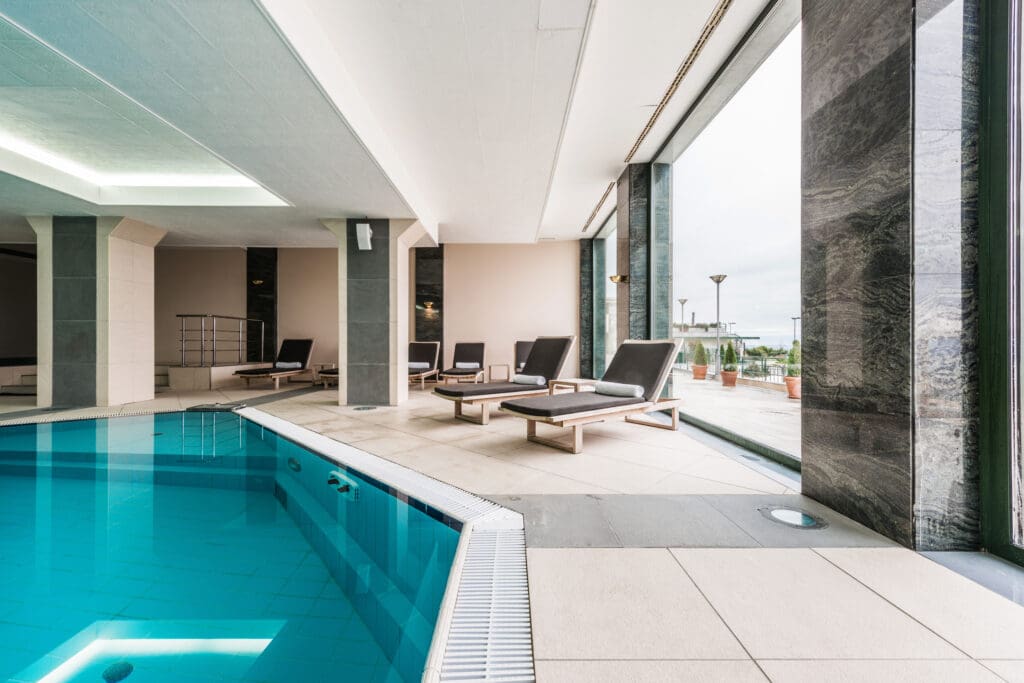
Pools, spas, commercial kitchens, laundries, restaurants, and fitness centres all create energy loads that have no equivalent in commercial office buildings. NABERS normalises for these in its assessment methodology — a hotel with a large heated pool is benchmarked against peer hotels with similar amenities — but optimising those loads operationally requires specific expertise and monitoring capability that differs significantly from standard building analytics.
What Drives NABERS Hotel Rating Improvement in Practice
NABERS hotel performance
What drives rating improvement in practice
Six operational opportunities — no capital expenditure required
buenoanalytics.com — NABERS for Hotels: What Every Hotel Owner and Operator Needs to Know
Experience across premium hotel operations — from large urban precincts to international luxury brands operating at near-constant occupancy — consistently identifies the same categories of operational opportunity. These are not capital projects. They are available in virtually every hotel that has not previously applied continuous analytics to its building systems.
HVAC scheduling and load alignment. Hotels frequently run central plant at full design capacity regardless of actual occupancy load. A hotel at 40% occupancy does not need the same chilled water supply as a hotel at 95% occupancy. Identifying and correcting these mismatches — through schedule optimisation, setpoint adjustment, and sequencing logic — typically delivers the largest single category of energy saving in any hotel building.
Simultaneous heating and cooling. A common and costly inefficiency where guest rooms or common areas are being heated and cooled at the same time — often the result of control sequences that have never been tuned for the building’s actual operating conditions. Detecting and resolving this typically delivers immediate and measurable energy reduction without any change to guest-facing systems.
After-hours and low-occupancy operation. Equipment running at full capacity in areas that are empty or at minimal occupancy — conference facilities overnight, restaurant HVAC during kitchen closure, spa plant outside operating hours. Identifying these patterns requires visibility at the system level, not just at the meter level.
Equipment fault detection before failure. Hotels that run maintenance reactively wait for equipment to fail before addressing it. Analytics-based fault detection identifies the early signatures of equipment degradation — a chiller approaching a compressor fault, a cooling tower fan running at abnormal speed, a VAV box with a stuck actuator — and enables targeted intervention before the fault affects guest comfort or energy performance.
Guest room unit monitoring. Individual fan coil units and room air conditioning systems degrade at different rates. Traditional scheduled maintenance treats all rooms identically. Analytics identifies which specific units are failing to achieve setpoint, allowing maintenance teams to intervene precisely where needed — protecting both guest comfort and the energy performance that contributes to the NABERS rating. This approach replaces broad scheduled maintenance with evidence-based targeted intervention, improving both room availability and maintenance efficiency.
Hot water and laundry optimisation. In full-service hotels, hot water and laundry are significant energy consumers that are often unmetered at the system level and therefore unmanaged. Sub-metering and analytics visibility into these loads creates optimisation opportunities that are frequently overlooked.
The NABERS Hotel Assessment Process — What to Expect
A NABERS hotel assessment requires 12 months of verified operational energy data covering the full building — all electricity and gas consumption across guest rooms, common areas, and back-of-house facilities. Only a NABERS accredited assessor can conduct the assessment and certify the rating.
For hotels that do not yet have a current NABERS rating, the process typically begins with establishing a baseline — understanding current performance across all systems, identifying the highest-impact improvement opportunities, and building the 12-month data record needed for the first assessment. For hotels with an existing rating, the focus shifts to continuous monitoring to prevent drift between assessments and identify the operational changes that will move the rating upward at the next cycle.
Unlike commercial office buildings where a building management system is typically the primary data source, many hotel buildings — particularly older or independently operated properties — may not have a comprehensive BMS. NABERS for Hotels can work with interval meter data in many cases, which means the barrier to achieving a first rating is lower than many hotel operators expect. The key is having a reliable, continuous, and verifiable energy data record across the full 12-month period.

The Timeline Case for Acting Now
The commercial case for pursuing a strong NABERS hotel rating has never been clearer — and the cost of inaction has never been higher.
Government travel spend is already flowing preferentially to rated hotels. Corporate travel managers are following the same path, driven by Scope 3 emissions reporting requirements that make accommodation choices a quantifiable sustainability decision. Major booking platforms are surfacing NABERS ratings to leisure travellers. The market leaders — including major international chains and Australia’s largest hotel groups — are already enrolled in NABERS programmes at scale.
The parallel with the office market is exact and instructive. Twenty years ago, a small number of progressive office landlords pursued NABERS ratings voluntarily, ahead of any mandate. They built operational expertise, achieved strong ratings, and were commercially well-positioned when government mandates arrived. The landlords who waited found themselves scrambling to meet requirements their buildings were not managed to achieve — and paying the commercial price in lost government tenancies and underperforming assets.
Hotel owners who begin the NABERS process now — building the 12-month data record, identifying and implementing operational improvements, and achieving a verified rating before minimum standards are formalised — will be in the same commercially advantaged position those early CRE adopters were in 20 years ago.
The minimum standard for government hotel bookings is expected to be set at approximately 4 stars. Achieving and maintaining 4 stars requires real operational improvement for most hotels currently operating without continuous energy management. The preparation time for a hotel starting from scratch is typically 12 to 18 months before a strong first rating can be achieved. That clock is running now.
How Bueno Supports NABERS Performance in Hotels
Bueno’s work in the hotel sector spans premium urban hotels, luxury international properties, and large multi-building resort and entertainment precincts across Australia and internationally. This experience has given us a clear and specific understanding of the operational patterns, system configurations, and organisational dynamics that determine NABERS outcomes in hospitality environments.
Bueno connects directly to a hotel’s existing building management systems and sub-metering infrastructure — without requiring hardware replacement in most cases — and provides continuous analytics across all building systems. The platform identifies the specific operational inefficiencies that drive energy waste in hotel environments: HVAC scheduling mismatches, simultaneous heating and cooling, after-hours equipment operation, individual room unit failures, and equipment fault patterns that precede failure and degraded performance.
For hotels working toward a first NABERS rating, Bueno provides the continuous data platform that makes the 12-month energy record clean, complete, and assessor-ready. For hotels with existing ratings working to improve or maintain their star level, Bueno provides the ongoing monitoring that prevents performance drift between annual assessments.
Every optimisation recommendation Bueno generates for a hotel environment is evaluated against the guest comfort imperative. The platform distinguishes between energy waste that can be eliminated without affecting guests and operational consumption that is genuinely driven by guest presence and need. This distinction — between waste and necessary consumption — is the foundation of NABERS improvement in hotels that does not compromise the guest experience.
Want to learn more?
To learn more about how Bueno supports NABERS performance for Australian hotels, visit our Hotels & Resorts industry page or speak to our team.