
Refrigerant Leak Detection for Grocery
A fast, scalable way to detect refrigerant leaks and support regulatory compliance at scale.
Bueno’s Refrigerant Leak Detection is a fast, scalable and cost-effective starting point for grocery and retail networks looking to improve refrigeration oversight and stay ahead of tightening leak detection regulations. It uses indirect detection to monitor refrigerant levels from data your controllers already log, without the cost or complexity of full-store analytics and with no new sensors. It connects to any controller or BMS from any manufacturer, and it is lab calibrated every year to meet the AIM Act’s annual calibration requirement.
By connecting to the rack controllers, the solution enables rapid deployment, accurate leak reporting and portfolio-wide compliance support with minimal disruption. Bueno connects to the rack controller once and reads the points it needs, so you can get started quickly.
It’s a simple first step toward smarter refrigeration management, lower leak rates and long-term cost savings.
AT A GLANCE
37%
Reduction in refrigerant leak rate
10+ years
Of proven performance in grocery
5 min
Data analysed every 5 minutes
Connects
To any rack, from any controller or BMS
Key facts about Refrigerant Leak Detection
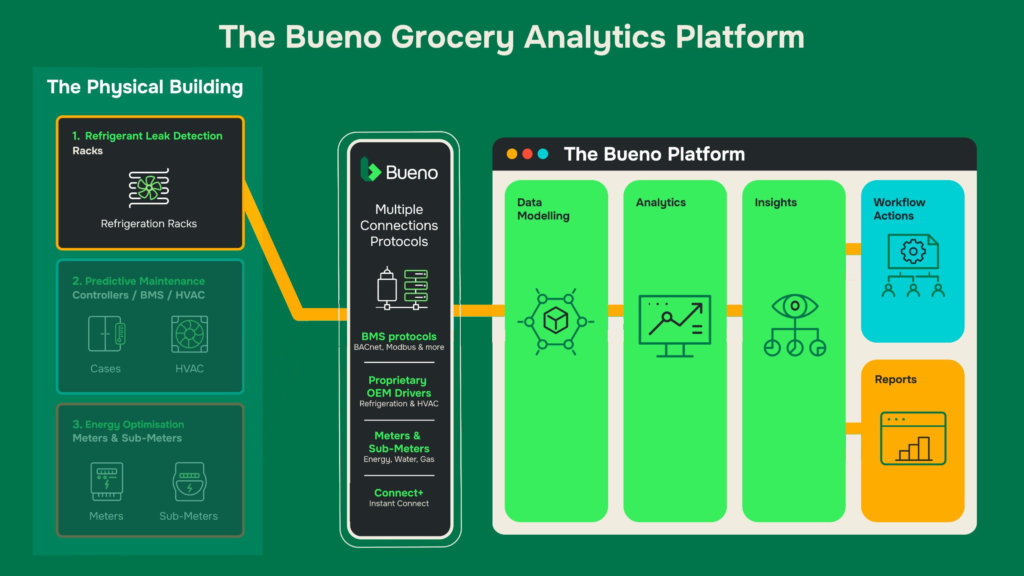
- Refrigerant Leak Detection is one of three Bueno grocery solutions, with Predictive Maintenance and Energy Optimisation. All three run on one data model and the same connections.
- It is indirect leak detection. A model learns each rack’s normal receiver level, and Bueno flags the leak when the actual level drifts below the prediction, well before a low-level alarm.
- It uses data already in your controllers: receiver levels, pressures, compressor run status and valve positions. No new sensors are required.
- Bueno is agnostic. It connects to any controller or BMS from any manufacturer. Bueno connects to each rack controller once and reads the points it needs.
- 300+ engineering rules and machine learning run on 5 minute data. AI ranks findings by cost and urgency and writes the work order in plain language. Your technician finds and fixes the leak.
- Bueno is lab calibrated every year, which meets the annual calibration requirement for automatic leak detection systems under the American Innovation and Manufacturing (AIM) Act in the US.
- At Woolworths, over a decade, the refrigerant leak rate fell by 37%, to 8 to 9%.
What is indirect refrigerant leak detection?
Data already in your controllers
- Receiver levels
- Pressures
- Compressor run status
- Valve positions
- No new sensors required
Key terms in refrigerant leak detection
Indirect leak detection
Receiver level
Fill and flee
Automatic leak detection system (ALDS)
How does Bueno flag a leak before the low-level alarm?
- A model learns each rack's normal receiver level from compressor runtime, pressures and valve positions.
- When the actual level drifts below the prediction, that gap is the leak. It is flagged well before a low-level alarm.
- Separate checks catch sudden losses, and fill and flee: a top-up with no repair.
- Where leak sensors exist, their readings add confidence.
Receiver level, one rack
How does indirect leak detection compare with sensor based detection?
| Topic | Sensor Based (Direct) | Bueno Indirect |
|---|---|---|
| What it detects | Refrigerant escaping next to the sensor | Drift of the refrigerant level from a live model, anywhere in the system |
| Coverage | Only where a sensor is installed. Most stores never achieve full coverage on rooftop or outdoor equipment | Whole system, including places without physical sensors |
| Installation | Sensors to buy and install across the site | Connects once to the rack controller, with no new sensors |
| Calibration | Costly annual calibration to stay compliant | No sensor calibration costs. Bueno itself is lab calibrated every year |
Why does refrigerant leak detection matter for grocery now?
Legislation is moving
Refrigerant management
Technician capacity
Cost and efficiency
What do the rules require for automatic leak detection?
| Region | Rule | What it says about automatic leak detection |
|---|---|---|
| United States | AIM Act, 40 CFR 84.108 | Automatic leak detection is required for commercial refrigeration appliances with a full charge of 1,500 lb or more of refrigerant with a global warming potential above 53. The system must be audited and calibrated annually, and a compliant system can replace routine leak inspections on the part of the appliance it monitors. New appliances need it from 1 January 2026, and existing appliances installed since 2017 by 1 January 2027. |
| European Union | Regulation (EU) 2024/573, Articles 5 and 6 | Equipment holding 500 tonnes of CO2 equivalent or more of fluorinated gases must have a leak detection system that alerts the operator. For smaller equipment, a leak detection system lengthens the interval between manual leak checks. |
| United Kingdom | UK F gas rules | A leak detection system must be fitted where equipment holds F gas equivalent to 500 tonnes of CO2 or more. A leak detection system doubles the allowed period between manual leak checks. |
How does Bueno connect to refrigeration controllers and BMS?
 AI
| Solution | Connections It Reads | What It Delivers |
|---|---|---|
| Refrigerant Leak Detection | Rack controllers | Lower leak rates, regulatory compliance, fewer emergency callouts, evidence backed reporting, foundation for optimisation |
| Predictive Maintenance | Rack controllers, case controllers, HVAC BMS | Fewer after hours callouts, early warning on alarms, condition based maintenance, one visit with multiple fixes, longer equipment life |
| Energy Optimisation | Rack controllers, case controllers, HVAC BMS, meters and sub-meters | Reduced energy drift, lower operating costs, optimised system performance, data backed prioritisation, improved sustainability |
How does a flagged leak become a repair?
1
Connect
2
Detect
3
Prioritise
4
Act
No more fill and flee
How is Bueno calibrated and documented each year?
- Lab calibrated annually, not guesswork.
- No ongoing sensor calibration costs to stay compliant.
- A decade of field proven performance, backed by thousands of completed work orders.
- A timestamped record of each flagged leak and repair, for audits and reporting.
What results has Bueno delivered?
37%
2,000+
10+ years
178,000+
Which Bueno solution should I start with?
1
Refrigerant Leak Detection
Find It
2
Predictive Maintenance
Fix It
3
Energy Optimisation
Save It
How does a rollout typically start?
1
Discovery
2
Pilot plan
3
Pilot
Refrigerant Leak Detection FAQ
What is indirect refrigerant leak detection?
Indirect leak detection finds leaks by reading the data your rack and fridge controllers already produce, building a live model of what refrigerant levels should be, and flagging the moment actual levels drift from it. It covers the whole system, not only the places where a sensor happens to sit.
How does Bueno detect a leak without leak sensors?
A model learns each rack's normal receiver level from compressor runtime, pressures and valve positions. When the actual level drifts below the prediction, that gap is the leak, flagged well before a low-level alarm.
Do I need new sensors or hardware?
No. The receiver levels, pressures, compressor run status and valve positions Bueno uses are already logged in your controllers. Bueno connects to the rack controller once and reads the points it needs.
Does Bueno work with my controllers and building management system (BMS)?
Yes. Bueno is agnostic and connects to any controller or BMS from any manufacturer, through a gateway, API, proprietary protocols or Connect+.
What is fill and flee, and can Bueno catch it?
When a technician cannot find a leak, some simply top up the refrigerant and move on. Bueno flags that pattern, a sudden refill followed by continued decline, so an incomplete repair is not logged as a fix.
Can I use Bueno alongside direct leak sensors?
Yes. Where leak sensors exist, their readings add confidence to the model, so the two together give the strongest coverage.
Is Bueno calibrated each year?
Yes. Bueno is lab calibrated every year, in line with the annual calibration requirement for automatic leak detection systems under the American Innovation and Manufacturing (AIM) Act in the US.
Which rules require automatic leak detection?
In the US, the AIM Act requires it for commercial refrigeration appliances of 1,500 lb or more of refrigerant with a global warming potential above 53. In the EU and UK, equipment of 500 tonnes of CO2 equivalent or more of fluorinated gases needs a leak detection system.
What results has Bueno delivered?
At Woolworths, over a decade, a 37% lower refrigerant leak rate, now 8 to 9%, and more than 2,000 service calls avoided.
Which connections does each Bueno grocery solution use?
Refrigerant Leak Detection reads rack controllers. Predictive Maintenance reads rack controllers, case controllers and the HVAC BMS. Energy Optimisation reads those and adds meters and sub-meters. All three use the same connections.