
Predictive Maintenance for Grocery
Find refrigeration problems days before they become after hours callouts.
Bueno’s Predictive Maintenance flags the equipment that needs attention before it fails, across your refrigeration and HVAC network, using the data your controllers already produce. It spots high temperature alarms days ahead, shows condenser decline and compressor floodback early, and pools the flagged jobs into one planned visit instead of several separate truck rolls. It connects to any controller or building management system (BMS) from any manufacturer, with no new sensors, and your technician makes every repair.
Instead of reacting to failures, or servicing every unit on a fixed calendar whether it needs it or not, your team works from the condition of the equipment, with jobs ranked by urgency and cost.
Bueno is the most advanced predictive maintenance platform in grocery. It moves your team from emergency dispatches to planned work, with fewer callouts, longer equipment life and lower maintenance and energy costs.
AT A GLANCE
22%+
Reduction in maintenance call-outs
5 to 7 days
Warning before a high temperature alarm, for case icing
95%
Predictive accuracy on ice-up forecasting at Woolworths
Connects
To racks, cases and HVAC, from any controller or BMS
Key facts about Predictive Maintenance
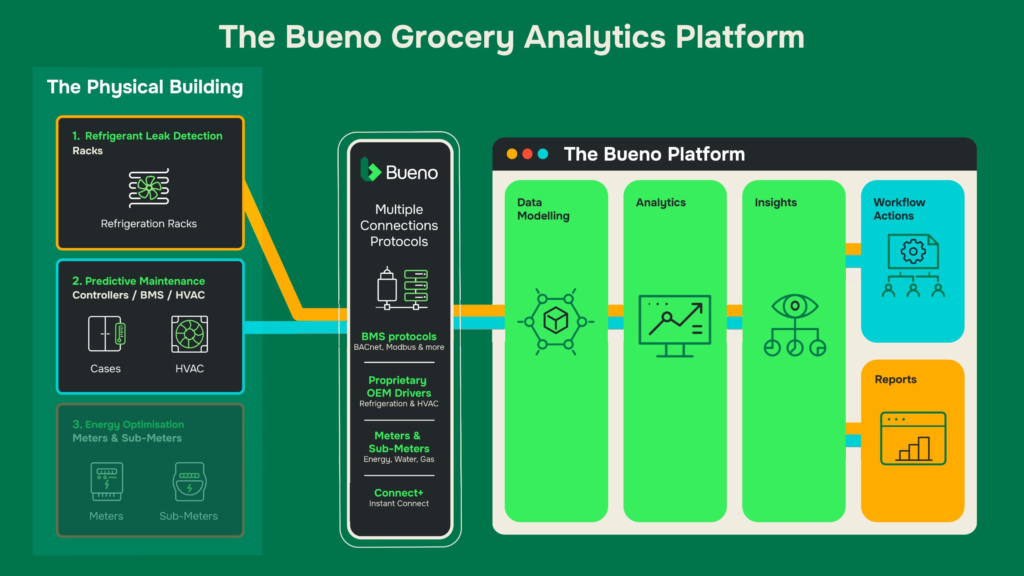
- Predictive Maintenance is one of three Bueno grocery solutions, with Refrigerant Leak Detection and Energy Optimisation. All three run on one data model.
- It finds equipment problems before they cause a failure, using data your controllers already produce. No new sensors are required.
- For example, case icing is spotted 5 to 7 days before the high temperature alarm, 95% accurate at Woolworths, so the fix is a planned daytime visit, not an after hours callout.
- It also flags condensers running outside their expected performance, and compressor floodback, with the case causing it identified.
- Maintenance is triggered by what the equipment is actually doing, not by a fixed calendar. Flagged jobs are pooled into one planned visit.
- Bueno is agnostic. It connects to any controller or BMS from any manufacturer. Bueno finds, ranks and recommends, and your technician makes every repair. It never controls your equipment.
- At Woolworths, Bueno predicts about 1,800 case icing events a year and has cut ice-up related callouts by 22%.
What is predictive maintenance in grocery refrigeration?
Predictive maintenance finds equipment problems before they cause a failure, by reading the operating data of the equipment itself. Bueno analyses the data your rack, case and HVAC controllers already produce every 5 minutes, and flags the trends that come before a fault, such as case temperature creeping up as ice builds on a coil.
That changes how work gets done. Instead of waiting for equipment to fail, or servicing every unit on a fixed calendar, your team works from the condition of the equipment, and Bueno pools the flagged jobs for a site into one planned visit.
Data already in your controllers
- Case temperatures
- Compressor behaviour
- Condenser performance
- HVAC data
- No new sensors required
Key terms in predictive maintenance
Predictive maintenance
Fixing equipment before it fails, because operating data shows it is heading toward a fault.
Condition based maintenance
Servicing equipment when its actual condition calls for it, not on a fixed calendar.
Case icing
Ice building on the coil of a display case, which pushes case temperature up between defrosts until it triggers a high temperature alarm.
Compressor floodback
Liquid refrigerant returning to the compressor, which can shorten compressor life.
WHAT BUENO PREDICTS
What does Bueno predict in grocery refrigeration and HVAC?
Bueno predicts the faults behind most after hours callouts and flags them early enough to plan the fix.
High temperature alarms, solved early
Up to 50% of refrigeration service calls start as a high temperature alarm. Bueno predicts these 5 to 7 days out, 95% accurate at Woolworths, so the fix is planned, not an after hours callout.
Condenser health, on data not a calendar
Bueno flags condensers running outside their expected performance envelope, so coil cleans are scheduled from actual degradation, not a fixed calendar interval.
Compressor floodback, with root cause
Bueno catches intermittent floodback earlier to maximise compressor life, and tells you which case is causing the issue, so your technician saves time on the callout.
Condition based, not calendar based
Maintenance is triggered by what the equipment is actually doing. Service visits are scheduled from real performance data, not a fixed timetable that checks everything regardless of need.
One platform across refrigeration, HVAC and energy
Bueno pulls refrigeration, HVAC and energy performance together into a single platform across your portfolio, so every store, and the network as a whole, is visible from one place.
EXAMPLE: CASE ICING
What does a Bueno prediction look like in practice?
Case icing is one example of the faults Bueno predicts. Bueno spots it by tracking how case temperature creeps up between defrosts as ice builds on the coil, and flags the trend 5 to 7 days before the high temperature alarm, which leaves about 6 days to plan the fix.
- Case temperature creeps up between defrosts as ice builds on the coil.
- Bueno spots the trend 5 to 7 days before the high temperature alarm, 95% accurate at Woolworths.
- The fix becomes a planned daytime visit, not an after hours emergency.
- At Woolworths, about 1,800 icing events are predicted a year, with 22% fewer ice-up callouts.
Example: case temperature, one display case
How does predictive maintenance compare with reactive and scheduled maintenance?
Predictive maintenance acts before a failure and only where it is needed, while reactive maintenance waits for the failure and scheduled maintenance visits every unit on the calendar.
| Topic | Reactive | Scheduled (Calendar) | Bueno Predictive |
|---|---|---|---|
| What triggers the work | The equipment fails | A fixed calendar | Bueno flags which equipment needs attention |
| When the fix happens | After it fails, often after hours | Whether the equipment needs it or not | Before it fails |
| Visits | A technician is dispatched for each failure | Every piece of equipment is checked | Jobs are pooled into a single planned visit |
Why does grocery maintenance need to change now?
Grocery maintenance needs to change now because labour market constraints are increasing, budgets are under pressure and planned preventive maintenance models are 40 years old.
Technician capacity
Constraints in the labour market are increasing. Every wasted or after hours callout uses up scarce capacity.
The maintenance model
Heat waves, water shortages and cost increases are putting pressure on maintenance budgets. Planned preventive maintenance (PPM) models are 40 years old.
Alarm driven callouts
Up to 50% of refrigeration service calls start as a high temperature alarm. Predicting those alarms turns an emergency into a planned visit.
Energy cost
Refrigeration is often a store’s largest load. Small drift, repeated across hundreds of stores, becomes a big number.
How does Bueno connect to refrigeration and HVAC controllers?
Predictive Maintenance reads the rack controllers, case controllers and HVAC BMS you already have, from any manufacturer, through a gateway, API or proprietary protocols, including Connect+. No new sensors are needed.
That same data model powers all three Bueno grocery solutions: Refrigerant Leak Detection, Predictive Maintenance and Energy Optimisation. Select a solution in the diagram to see which connections it reads and what it delivers.
 AI
| Solution | Connections It Reads | What It Delivers |
|---|---|---|
| Refrigerant Leak Detection | Rack controllers | Lower leak rates, regulatory compliance, fewer emergency callouts, evidence backed reporting, foundation for optimisation |
| Predictive Maintenance | Rack controllers, case controllers, HVAC BMS | Fewer after hours callouts, early warning on alarms, condition based maintenance, one visit with multiple fixes, longer equipment life |
| Energy Optimisation | Rack controllers, case controllers, HVAC BMS, meters and sub-meters | Reduced energy drift, lower operating costs, optimised system performance, data backed prioritisation, improved sustainability |
How does a flagged fault become a planned visit?
Bueno turns a flagged fault into a planned visit in a short loop that takes controller data to a finished repair, and gets smarter each time.
1
Connect
2
Detect
3
Prioritise
4
Act
One visit, multiple fixes
When a predictive alert brings a technician to site, Bueno surfaces every other flagged issue at that location too. The real jobs are pooled into one visit instead of three separate truck rolls.
What results has Bueno delivered?
At Woolworths, Bueno’s predictive analytics have moved maintenance from reactive fixes to proactive prevention across more than 1,200 stores since 2016. Across a decade, Bueno has also delivered a 20% reduction in energy consumption and about AUD 9,000 (about US$6,200) in savings per store per year, across energy, refrigerant and predictive maintenance.
22%
Reduction in refrigeration ice-up related callouts
95%
Predictive accuracy on ice-up forecasting
4,400+
Work orders raised in the last 12 months
178,000+
Connected devices across 1,200+ stores
Which Bueno solution should I start with?
Refrigerant Leak Detection, Predictive Maintenance and Energy Optimisation run on one data model, so you can start with any of them and add the others.
Find It
2
Predictive Maintenance
Fix It
3
Energy Optimisation
Save It
How does a rollout typically start?
1
Discovery
2
Pilot plan
3
Pilot
Predictive Maintenance FAQ
What is predictive maintenance in grocery refrigeration?
Predictive maintenance finds equipment problems before they cause a failure, by reading the data your rack, case and HVAC controllers already produce. Your team fixes the problem in a planned visit instead of reacting to an alarm.
How far ahead can Bueno predict a refrigeration fault?
For case icing, Bueno spots the trend 5 to 7 days before the high temperature alarm, 95% accurate at Woolworths. That turns an after hours emergency into a planned daytime visit.
What does Bueno predict?
Bueno predicts high temperature alarms, flags condensers running outside their expected performance, and catches compressor floodback early, with the case causing it identified.
Is predictive maintenance the same as condition based maintenance?
Condition based maintenance is part of it. Bueno triggers maintenance from what the equipment is actually doing, not from a fixed calendar.
Do I need new sensors or hardware?
No. Bueno uses the data your controllers already produce, so no new sensors are required.
Does Bueno work with my controllers and building management system (BMS)?
Yes. Bueno is agnostic and connects to any controller or BMS from any manufacturer, through a gateway, API, proprietary protocols or Connect+.
Does Bueno change my equipment settings automatically?
No. Bueno finds, ranks and recommends. Your technician or contractor makes every repair and every change.
How does Bueno reduce callouts and truck rolls?
Bueno predicts alarms days ahead so the fix can be planned, and pools every flagged issue at a site into one visit instead of several separate truck rolls.
What results has Bueno delivered?
At Woolworths, since 2016, 22% fewer ice-up related callouts and 95% predictive accuracy on ice-up forecasting, with about 1,800 icing events predicted each year. Across energy, refrigerant and predictive maintenance together, Woolworths has seen a 20% reduction in energy consumption and about AUD 9,000 (about US$6,200) in savings per store per year.
Which connections does each Bueno grocery solution use?
Refrigerant Leak Detection reads rack controllers. Predictive Maintenance reads rack controllers, case controllers and the HVAC BMS. Energy Optimisation reads those and adds meters and sub-meters. All three run on one data model.
Talk to Bueno about predictive maintenance for your network
Speak with Bueno about predicting equipment faults early, so your team plans the fix instead of reacting to the alarm.