
Building Optimisation for Commercial Buildings
From fixing faults to sustained, whole building performance.
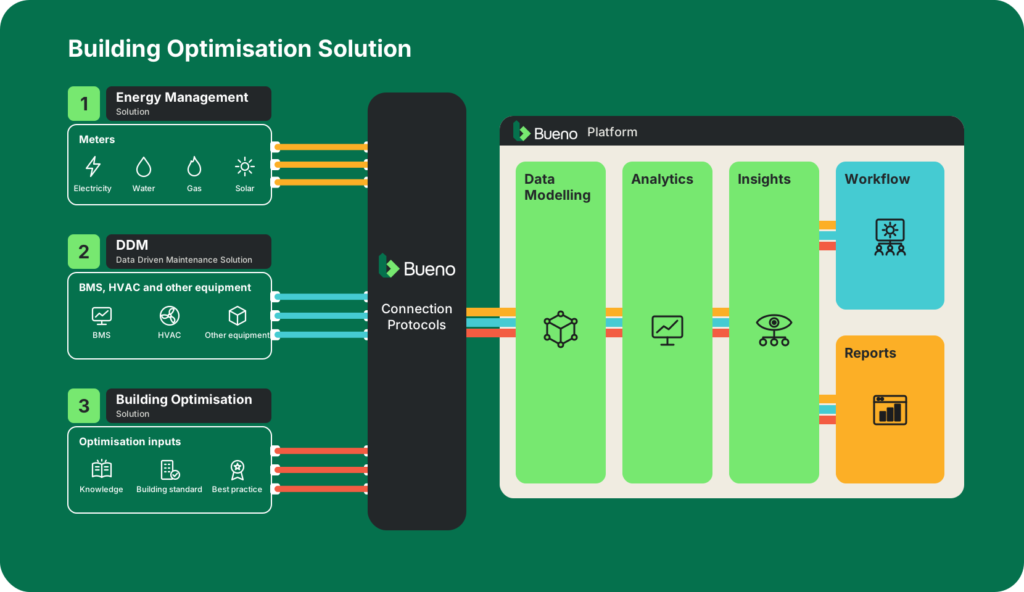
Building Optimisation is the third of Bueno’s three solutions. It builds on Energy Management and Data Driven Maintenance (DDM), and uses all available data, from meters and the building management system (BMS) to other equipment such as lights, lifts, fire panels and Internet of Things (IoT) devices, together with Bueno’s knowledge, standards and best practice. It recommends how the whole building should run, then tracks whether the improvements hold. It runs on 350+ rules and AI, data is analysed near real-time every 5 minutes, and your team or contractor makes every change.
Also known as: Building Optimisation is closely related to continuous commissioning and monitoring based commissioning (MBCx) in some markets. The concept is the same: use measured data to keep a whole building performing at its best.
AT A GLANCE
350+
Rules, including the DDM and Energy Management rules
5 min
All data
Meters, BMS and other equipment such as lights, lifts, fire panels and IoT devices
Monthly
Building Performance tracking (like NABERS, Energy Star, Green Star) with roadmaps
KEY FACTS
Key facts about Building Optimisation
- Building Optimisation is the third of Bueno’s three solutions: Energy Management, Data Driven Maintenance (DDM) and Optimisation. Each includes the one before it.
- It uses all available data: meters, BMS and other equipment such as lights, lifts, fire panels and IoT devices, plus Bueno’s knowledge, standards and best practice.
- It runs on 350+ rules, including the DDM and Energy Management rules, with data analysed near real-time, every 5 minutes.
- It recommends how the whole building should operate across seasons, systems and occupancy, then tracks whether the improvements hold and flags performance slippage.
- Bueno doesn’t rate or certify buildings. Bueno tracks performance, including monthly National Australian Built Environment Rating System (NABERS) tracking, and provides roadmaps. Optimisation is where the biggest improvements happen.
- It gives teams evidence for capital expenditure (CAPEX) planning, and verified results to validate performance contracts and upgrades.
- Bueno analyses and recommends. Your team or contractor makes every change, and Bueno never controls equipment automatically or writes setpoints.
Just getting started?
Optimisation builds on Energy Management and Data Driven Maintenance (DDM), which come first.
Jump to the journey
What is Building Optimisation?
Building Optimisation is the practice of continuously improving how a whole building operates, so it reaches and holds its best performance. Bueno’s Optimisation solution takes the trusted energy data from Energy Management and the ranked, verified faults from DDM, adds data from other equipment and Bueno’s knowledge, standards and best practice, and recommends improvements to control strategies, equipment efficiency and comfort.
It then tracks whether the improvements hold, flags performance slippage and gives teams evidence for ratings, reporting and capital planning, whether they manage a single asset or an international portfolio.
Global Definitions
WHY GO BEYOND FAULTS
Why is fixing faults not enough to reach peak performance?
Because fixing a fault returns equipment to normal, but it doesn’t change how the whole building is controlled, scheduled and tuned. Buildings drift, seasons change and occupancy shifts, so a building can be fault free and still waste energy or miss its rating target.
Optimisation takes the intelligence from Energy Management and DDM and turns it into sustained, portfolio wide improvement, so performance doesn’t fade after the tune up.
| Solution | What It Does | Where It Stops |
|---|---|---|
| Energy Management | Shows where energy goes and flags deviations | Doesn't say what to change |
| DDM | Finds, ranks and verifies the fixing of faults | Returns equipment to normal, but doesn't tune how the whole building runs |
| Optimisation | Recommends how the whole building should run, and tracks whether it holds | Builds on trusted data and fixed faults, which is why it comes third |
OPTIMISATION OUTCOMES
What Outcomes Does Optimisation Deliver?
Optimisation builds on Energy Management and DDM to improve how the whole building performs. It delivers lower energy use, stronger ratings, smarter capital planning and stronger asset value. Select a solution below to see how the outcomes build.

How does Building Optimisation work?
It’s a continuous loop of five stages that takes everything Bueno knows about a building and turns it into improvements that last.
Collect
Bueno brings together near real-time data from meters, the BMS and other equipment such as lights, lifts, fire panels and IoT devices, every 5 minutes.
Analyse
350+ rules, AI and weather normalised benchmarking assess performance against design intent, similar buildings and Bueno's knowledge, standards and best practice.
Recommend
Opportunities in control logic, equipment efficiency and comfort are ranked by impact, so teams know what to tune first.
Act
Your team or contractor implements the recommended changes through existing workflows, guided by a roadmap. Bueno never makes the change.
Sustain
Results are verified, performance slippage is flagged and progress is tracked against targets and ratings, so improvements hold.
The loop closes, and the building keeps improving, because every verified result feeds the next recommendation.
WHAT YOU CAN ACHIEVE
What can Optimisation help a portfolio achieve?
Optimisation supports three jobs: lifting performance, giving teams visibility across the portfolio, and planning the next investment. Bueno measures and reports what the data shows rather than assuming it.
Performance Uplift
- Consistent tuning recommendations across diverse building types
- Verified energy savings from improved performance
- Fewer manual overrides and inefficiencies, sustained over time
- Progress tracked toward NABERS and other ratings targets
Visibility and Insight
- Portfolio wide visibility of optimisation opportunities
- Asset level key performance indicators (KPIs) to find and address underperformance
- A record of recommended strategies and their results
- Optimisation data feeding energy and ESG reporting
Strategic Planning
- Capital expenditure (CAPEX) priorities identified through persistent performance gaps
- Equipment life extended through proactive tuning recommendations
- Performance contracts and capital upgrades validated with data
- Operations aligned with net zero and broader sustainability goals
How it typically starts
Start with trusted energy data (Energy Management)
Fix the faults that waste energy (DDM)
Extend to Optimisation across the portfolio and track the results
OPTIMISATION AND THE JOURNEY
How does Optimisation fit with Energy Management and DDM?
Energy Management shows where energy goes. DDM decides what to fix, who does it and when, then verifies the outcome. Optimisation then improves how the whole building runs, across seasons, systems and occupancy.
Energy Management
Shows you where energy goes
Where energy is used, where it is drifting and how much is being used.
DDM
Tells you what to fix
What is wrong, how urgent it is, who should act, and whether the fix worked.
Optimisation
This solutionMakes the whole building run better
How the building should operate at its best, and whether it stays there.
Fixing faults isn't the end of the journey. Optimisation uses the intelligence from the first two solutions to keep improving the whole building, and to prove the results.
What Optimisation includes
- Everything in Energy Management and DDM, including ranked and verified faults
- Asset optimisation analytics and performance reporting
- Comfort and indoor environment quality (IEQ) analysis
- Data and system uptime monitoring, with performance slippage alerts
- NABERS tracking and performance roadmaps
What you get
Energy Management shows where energy goes. DDM fixes what wastes it. Optimisation improves how the whole building runs.
How does Optimisation stop performance drifting, scale best practice and balance comfort with energy?
Buildings drift after they are tuned
Performance fades as equipment ages, seasons change and occupancy shifts. Optimisation monitors continuously, alerts on performance slippage and flags regression before it affects ratings, so improvements are sustained.
Best practice is hard to scale
Strategies that work in one building rarely transfer cleanly to another. Bueno adapts recommendations to asset type, age and capability, then scales them across hundreds of buildings while keeping customisation at site level.
Comfort and energy pull against each other
Balancing indoor environment quality (IEQ) zones for consistent comfort while cutting waste is hard to do by hand. Optimisation flags overcooling and overheating, reports on thermal comfort variance by zone and highlights poor performing zones for follow up.
WHY NOW
Why is the market moving toward Building Optimisation?
Net zero targets, rising costs and higher expectations from tenants and investors are pushing owners beyond fault fixing, toward buildings that keep performing.
Net zero and carbon targets
Owners need energy baselines that keep falling to meet reduction targets and ratings, not a one off tune up.
Asset value and tenant expectations
Stronger ratings and secure, easy access to tenancy data can support asset value, tenant attraction and investor confidence.
Grid demands and new regulation
Resilient, intelligent buildings are better placed to adapt to future grid demands, new regulations and changing tenant expectations.
Rising operating costs
Optimisation identifies opportunities to reduce operating costs, and gives business insight to help manage service vendors.
Capital constraints
Evidence of persistent performance gaps and verified results helps teams decide where capital spend will make a difference.
RATINGS AND ESG REPORTING
How does Optimisation help improve building performance and ratings?
Optimisation is where the biggest improvements happen. It builds on the energy tracking in Energy Management and the faults fixed in DDM, and provides data backed roadmaps to improve performance and ratings. Bueno doesn’t rate or certify buildings. Bueno tracks performance, including monthly NABERS tracking, so your team and your rating body can act on it.
Energy Management
Track
Tracks energy performance and ratings, including monthly NABERS tracking and ESG reporting inputs.
DDM
Fix the Faults
Finds and fixes the faults that waste energy.
Optimisation, this solution
Lift Performance
Where the biggest improvements happen, with data backed roadmaps to improve performance and ratings.
Ratings and Regulations That Reward Building Performance
Australia and New Zealand
National Australian Built Environment Rating System (NABERS). Green Star is a Green Building Council of Australia scheme, also used in New Zealand.
United Kingdom
Building Research Establishment Environmental Assessment Method (BREEAM). Energy Performance Certificates (EPC).
United States
Leadership in Energy and Environmental Design (LEED). Local Law 97 (LL97) and Building Emissions Reduction and Disclosure Ordinance (BERDO) are emissions regulations rather than ratings.
Investor Benchmark
GRESB
The Global Real Estate Sustainability Benchmark (GRESB) scores portfolios, not individual buildings. Participants receive a score out of 100 and a star rating from 1 to 5 against their peers, based on the ESG data they report. Energy and emissions data from Bueno supports that reporting.
Which Bueno solution should I start with?
Energy Management
See It
Trusted energy and water data from meters and sub-meters, 40 rules.
Start here if you don't yet trust your data or need ratings tracking and reporting.
DDM
Fix It
Faults found, ranked, assigned and verified, using meters and BMS data, 180 rules including Energy Management.
Start here if maintenance cost and faults are the problem.
Optimisation
Improve It
Whole building performance and ratings, held over time, using meters, BMS and other equipment such as lights, lifts, fire panels and Internet of Things (IoT) devices, 350+ rules including DDM.
Start here if you have energy and rating targets.
Each solution includes the one before it.
AI & INNOVATION
AI IN BUILDING OPTIMISATION
FAQ
How Does AI Improve Building Optimisation?
Building Optimisation is where Bueno’s AI works at full power. Artificial intelligence (AI) models detect, predict, prioritise and explain performance across whole portfolios. AI recommends and your team decides, and your team or contractor makes every change.
Job Pooling
AI groups and streamlines facilities management workflows.
Advanced Deployment
Scales fast across any asset mix.
Predictive Maintenance
Spots regression before it affects ratings.
Energy Slip AI
Detects drift, benchmarks sites and helps prove savings.
Continuous Learning
Accuracy improves with every data point.
LLM Querying
Ask natural language questions, get direct answers and break down barriers to insight.
The result: lower costs, stronger ratings and portfolios that stay optimised.
The Expert Platform for Improving Building Performance and Ratings
Bueno is an expert platform for improving building performance across the leading ratings and regulations, including NABERS, Green Star, BREEAM, LEED and LL97. Bueno doesn’t rate or certify buildings. Bueno tracks performance and provides roadmaps, so your team can act on them.





Smart Building Insights Across Your Entire Commercial Real Estate Portfolio
Discover Bueno’s capabilities across all asset classes
Building Optimisation FAQ
What is Building Optimisation in commercial buildings?
Building Optimisation continuously improves how a whole building operates, so it reaches and holds its best performance. Bueno's Optimisation solution is the third of three solutions, building on Energy Management and Data Driven Maintenance (DDM).
How is Optimisation different from Energy Management and DDM?
Energy Management shows where energy goes. DDM finds, ranks and verifies the fixing of faults. Optimisation then recommends how the whole building should run across seasons, systems and occupancy, and tracks whether the improvements hold. Each solution includes the one before it.
What data does Optimisation use?
All available data: meters, the building management system (BMS) and other equipment such as lights, lifts, fire panels and Internet of Things (IoT) devices, plus Bueno's knowledge, standards and best practice.
How often is data analysed?
Near real-time, every 5 minutes, using 350+ rules.
Does Bueno control our building systems or change setpoints automatically?
No. Bueno analyses and recommends. Your team or contractor makes every change, so you stay in control of your building.
How does Optimisation help with NABERS and other ratings?
Optimisation provides data backed roadmaps and tracks progress, including monthly tracking for the National Australian Built Environment Rating System (NABERS). Bueno doesn't rate or certify buildings, so your rating body or assessor still decides the rating.
Can Optimisation work across a portfolio of different buildings?
Yes. Bueno adapts recommendations to asset type, age and capability, and scales across hundreds of buildings while keeping customisation at site level.
How does Optimisation help with capital planning?
It identifies persistent performance gaps and verifies results, giving teams evidence for capital expenditure (CAPEX) priorities and to validate performance contracts and upgrades.
How is AI used in Building Optimisation?
Artificial intelligence (AI) groups work, detects drift, spots regression, benchmarks sites and answers natural language questions. AI recommends and your team decides.
Do we need Energy Management and DDM before Optimisation?
Optimisation includes both, because it depends on trusted energy data and fixed faults. Many portfolios start with whichever solution matches their biggest need, and Bueno builds from there.