If you operate grocery stores or supermarket networks in the United States, the American Innovation and Manufacturing Act — better known as the AIM Act — is one of the most consequential pieces of environmental regulation your business has faced in decades. Signed into law in December 2020 with broad bipartisan support, it sets in motion a structured phasedown of hydrofluorocarbons, the refrigerants that power the vast majority of commercial refrigeration systems in the US. For grocery operators, it creates a set of compliance obligations that are not future concerns — they are current requirements.
This article explains what the AIM Act is, how it is structured, what it specifically requires of supermarket and grocery store operators in 2026, and why analytics platforms are increasingly central to meeting those requirements.
What the AIM Act Is
The AIM Act gives the Environmental Protection Agency authority to address hydrofluorocarbons — a family of synthetic refrigerants commonly used in air conditioning and commercial refrigeration — in three ways. The first is a phasedown of HFC production and consumption through an allowance allocation program, targeting an 85% reduction in HFC use by 2036 relative to historic baselines. The second is a Technology Transitions program that restricts which refrigerants can be used in new equipment installations, sector by sector. The third is an Emissions Reduction and Reclamation program that sets detailed requirements around leak detection, repair timelines, recordkeeping, and reclamation.
All three pillars affect the grocery sector. But for most operators managing existing store portfolios right now, the third pillar — leak detection and emissions management — is where the most immediate compliance pressure lies.

The HFC Management Rule: What It Requires of Grocery Operators
The EPA’s HFC Management Rule, which came into effect January 1, 2026, imposes mandatory leak detection and repair requirements on owners and operators of any appliance containing 15 pounds or more of HFC refrigerant. For context, a typical supermarket rack system holds significantly more than that threshold, meaning virtually every commercial refrigeration system in a grocery network is now subject to these rules.
The core requirements are substantial. Operators must calculate the leak rate on every refrigerant addition. They must conduct verification testing after every repair. Appliances that cannot be repaired must have documented retrofit or retirement plans. Records of all activity — refrigerant additions, leak calculations, repairs, and service events — must be maintained and available for EPA audit at any time.
For large systems with a refrigerant charge of 1,500 pounds or more, the requirements go further. Automatic Leak Detection systems must be installed on all new equipment from January 1, 2026, and retrofitted onto existing systems by January 1, 2027. These systems must meet specific EPA specifications under 40 CFR 84.108 — they are not simply alarm systems, but verified continuous monitoring installations with defined performance thresholds.
Looking further ahead, from January 1, 2029, all servicing and repair of supermarket refrigeration systems must be performed using reclaimed HFCs. This requirement was built on the assumption that the leak detection and repair framework being established now would progressively improve refrigerant recovery rates and build reclaimed supply in the market. The two obligations are connected — how well operators manage leaks over the next three years will directly shape the availability and cost of reclaimed refrigerant when the 2029 mandate takes effect.
The financial exposure for non-compliance is not theoretical. Penalties can reach $57,000 per day, per violation under the AIM Act’s enforcement framework. The EPA also retains the ability to retroactively enforce violations for three years.
The Technology Transitions Rule: What Changed in May 2026
While the leak detection and reclamation requirements remain firmly in place, the Technology Transitions pillar of the AIM Act — which governs which refrigerants can be used in new equipment installations — underwent a significant revision in May 2026.
The original 2023 Technology Transitions Rule had set aggressive GWP limits for new refrigeration equipment: a maximum of 150 or 300 GWP for new supermarket systems, effective from early 2026. In practice, this would have required a rapid and widespread shift to natural refrigerants such as CO2 across the industry. Many grocery operators and industry groups raised concerns about cost, supply chain readiness, and the pace of transition.
On May 21, 2026, the EPA finalized a revised rule extending these deadlines substantially. New supermarket systems and remote condensing units may now use refrigerants with a GWP of up to 1,400 until January 1, 2032, at which point the original 150 or 300 GWP limits take effect. The EPA estimated the changes would save the supermarket sector more than $800 million in avoided engineering costs.
The practical implication for operators is that the pressure to immediately replace all HFC-based systems with CO2 alternatives has eased for the next several years. However, the 2032 deadline is fixed, and the HFC phasedown schedule — which reduces allowances for HFC production and consumption — remains unchanged. This means that even as the Technology Transitions deadline has shifted, the supply of traditional refrigerants will continue to tighten year on year, and their cost will continue to rise. Operators who use this window to proactively reduce leak rates and refrigerant consumption will be structurally advantaged when that pressure intensifies.
Why Leak Detection Is the Central Compliance Challenge
For most grocery networks, the hardest part of AIM Act compliance is not understanding the rules — it is operationalising them across a large, distributed portfolio of stores, each with multiple refrigeration racks, varying system ages, and often inconsistent maintenance histories.
Traditional approaches to refrigerant leak management have been reactive. A sensor detects gas after it has escaped into the environment, a technician is dispatched, and the charge is topped up. Under the AIM Act, this model is no longer adequate. The law requires continuous monitoring, documented leak rate calculations, and defined repair timelines — 30 days for standard repairs, with extensions available only for documented circumstances such as parts unavailability.
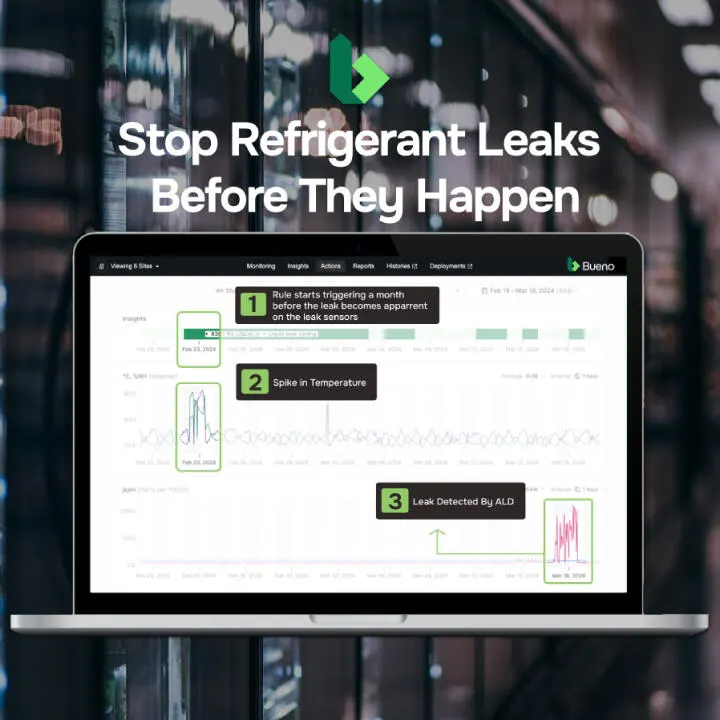
This is precisely where analytics-based indirect leak detection becomes relevant. Rather than waiting for refrigerant gas to be physically detected after a loss has already occurred, analytics platforms monitor the operational behaviour of refrigeration systems continuously — tracking pressure, temperature, compressor performance, and charge behaviour to identify the signatures of a developing leak before it becomes a compliance event. This approach enables operators to act earlier, document the detection and response, and build the audit-ready records that the HFC Management Rule now requires.
State-level regulations in markets like New York and Washington are in some cases stricter than the federal AIM Act baseline — New York’s Part 494 regulations, for example, require leak repair within 14 days rather than 30, and mandate quarterly inspections for systems with 200 pounds or more of refrigerant. Multi-state grocery networks operating in these jurisdictions must comply with the most stringent applicable requirement.
What This Means Practically for Grocery Operations Teams
For operations and sustainability teams managing US store portfolios in 2026, the AIM Act creates three immediate priorities.
The first is documentation. Every refrigerant addition, every leak calculation, every repair, and every service event must be recorded in a format that supports EPA audit. This is not a task that can be retrospectively assembled — it requires systems and processes that generate and store records continuously.
The second is leak rate management. The AIM Act’s “chronically leaking appliance” provisions mean that systems with persistent high leak rates face mandatory retrofit or retirement requirements. Understanding which systems in a portfolio are at risk — before they trigger that threshold — is both a compliance and a capital planning priority.
The third is ALD installation planning. For systems with 1,500 pounds or more of refrigerant, automatic leak detection systems must be in place on new installations now, and on existing systems by January 2027. This is a concrete infrastructure requirement with a firm deadline, not a recommendation.
The Role of Analytics in AIM Act Compliance
Bueno’s Refrigerant Leak Detection module was designed for exactly this operating environment. By connecting to existing refrigeration controllers without requiring additional hardware in most stores, it provides continuous monitoring of refrigerant charge behaviour across an entire portfolio — detecting the signatures of refrigerant loss before gas sensors trigger, generating the audit-ready reporting that AIM Act compliance demands, and prioritising investigations by confidence level so maintenance teams focus on the issues most likely to represent real leaks.
The module directly supports compliance with the HFC Management Rule’s requirement for documented detection and response, and integrates with portfolio-level reporting workflows to give sustainability and operations teams visibility across every site — not just the ones where an alarm has already fired.
In a regulatory environment where the cost of non-compliance is measured in tens of thousands of dollars per day, and where the supply of HFC refrigerants is structurally tightening year on year, early and accurate leak detection is not just an operational best practice. It is a compliance obligation and, increasingly, a commercial imperative.
To learn more about how Bueno supports AIM Act refrigerant compliance for US grocery operators, visit our Refrigerant Leak Detection module page or contact our team.