
The GRESB Score has become one of the most important benchmarks in global real estate. Investors, asset owners and sustainability leaders increasingly rely on GRESB to understand how well a building or portfolio is performing across environmental, social and governance (ESG) measures.
Yet many people still ask the same foundational questions:
What is GRESB? How does the scoring work? And how exactly can analytics improve a GRESB Score?
This article provides a clear, accessible overview for anyone trying to understand how the framework operates and why high-quality building data is now essential for improving performance.
What Is GRESB?
GRESB (Global Real Estate Sustainability Benchmark) is an annual ESG assessment used by property companies, REITs, fund managers and investors to benchmark their sustainability performance.
A GRESB Score evaluates two major areas:
Management – How strong the organisation’s ESG policies, governance structures and risk processes are.
Performance – How well the buildings actually perform in practice, based on measurable environmental data such as energy, emissions, water and waste.
At the end of the assessment, organisations receive:
• A numerical GRESB Score (0–100)
• A GRESB Rating (1–5 Stars)
• Peer comparison results
Investors increasingly use these scores to evaluate asset resilience, climate risk exposure and long-term value. In many markets, a high GRESB Score has become a requirement for attracting capital.
What is a GRESB Score?
A GRESB score is divided into two main components with different weightings:
1. Management Component – 30% of the GRESB Score
This section evaluates:
• ESG policies and procedures
• Leadership and governance
• Roles and responsibilities
• Risk management processes
• Stakeholder engagement
It mainly assesses how well sustainability is managed, not the environmental outcomes themselves.
Scores in this section are typically very high across most portfolios globally, because strong governance is now standard practice.
2. Performance Component – 70% of the GRESB Score
This is the section where most organisations struggle—and where the greatest opportunity for improvement lies.
GRESB analyses actual asset performance based on:
• Energy use
• GHG emissions
• Water consumption
• Waste management
• Building certifications
• Data coverage and completeness
• Year-on-year improvement
Performance accounts for the majority of the overall GRESB Score, and it relies entirely on accurate, complete, verifiable building data.
GRESB uses a materiality approach, meaning only relevant indicators (e.g., energy for offices, water for hotels) are scored. However, regardless of asset type, data quality and improvement trends are weighted heavily.
This is the part of GRESB where analytics has the biggest impact.
Why Building Analytics Is Essential for Improving a GRESB Score
Improving a GRESB Score is no longer about writing better policies. In most regions—especially the UK and Australia—the Management component of GRESB is already close to perfect. In 2023, the average Management score across UK participants was 29 out of 30, meaning almost every organisation has mature ESG governance, defined roles, risk assessments and stakeholder processes.
The real challenge—and the real opportunity—sits within the Performance component, which makes up 70% of the total GRESB Score.
And this is where most portfolios underperform.
Where Performance Scores Fall Behind (and Why It Matters)
The 2023 UK market averages reveal clear weaknesses in the indicators tied to actual building performance:
Data monitoring: 1.48 out of 5.5
Building certification: 7.38 out of 10.5
Energy: 8.4 out of 14
GHG emissions: 4.52 out of 7
Water: 2.86 out of 7
Waste: 2.27 out of 5.7
These categories represent the largest pool of unclaimed GRESB points, and all of them depend on the quality, completeness and accuracy of building data—something traditional processes cannot deliver at scale.
This is why analytics is now essential. It directly strengthens the weak parts of the GRESB Score.
How Building Analytics Fills the GRESB Performance Gap
To lift a GRESB Score, an organisation must demonstrate:
• reliable environmental data
• complete portfolio coverage
• measurable year-on-year improvement
• verified reductions in energy, emissions, water and waste
These are exactly the gaps where Performance scores are lowest—and exactly where analytics provides measurable uplift.
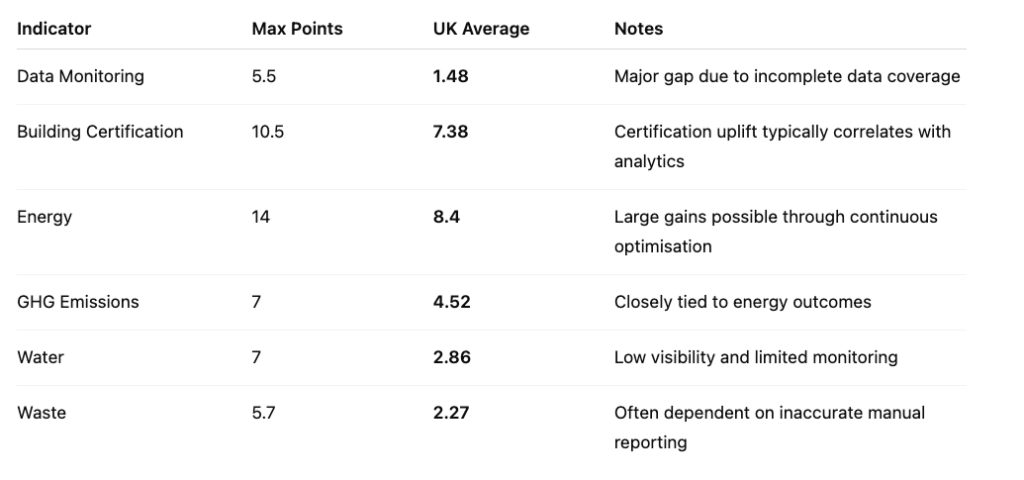
Below is how analytics aligns with each underperforming area of the GRESB Score.
1. Fixing Low Data Monitoring Scores (1.48 / 5.5)
GRESB heavily rewards complete, reliable datasets and penalises:
estimated values
partial coverage
missing meters
inconsistent reporting
Building analytics solves this through:
5-minute data capture
automated integrity checks
continuous validation of meters and sensors
full asset and portfolio coverage
This results in higher data completeness, a cleaner audit trail, and stronger scoring across all environmental indicators.
2. Improving Energy Scores (8.4 / 14)
Energy performance is the single largest contributor to the GRESB Score within the Performance component.
Analytics identifies and resolves:
energy drift
equipment running unnecessarily
BMS issues
simultaneous heating and cooling
faulty valves, sensors and dampers
These insights allow teams to achieve measurable, year-on-year energy reductions—something that GRESB explicitly rewards.
3. Increasing GHG Emissions Scores (4.52 / 7)
Emissions reduction is a direct outcome of:
energy optimisation
operational efficiency
avoided waste
better control of HVAC and plant sequences
Analytics provides:
emissions profiles
carbon modelling
weather-normalised baselines
continuous verification
This transforms emissions reporting from manual estimation to verifiable performance—boosting the GHG portion of the GRESB Score.
4. Strengthening Water Scores (2.86 / 7)
Many portfolios lack accurate water monitoring. Analytics improves:
leak detection
consumption tracking
anomaly identification
submeter completeness
These improvements deliver year-on-year consumption reductions—which is exactly how GRESB evaluates water performance.
5. Lifting Waste Scores (2.27 / 5.7)
Although waste performance is influenced by operational teams, analytics enhances:
measurement accuracy
contamination insights
reduction strategies
reporting consistency
Stronger data equals higher scoring against GRESB’s waste indicators.
6. Improving Building Certification Scores (7.38 / 10.5)
GRESB rewards third-party performance ratings such as:
NABERS (AU & UK)
NABERS UK Energy for Offices
ENERGY STAR
BREEAM In-Use
Building analytics provides the operational evidence required to achieve and maintain these certifications.
This is why markets with high NABERS adoption—particularly Australia—consistently achieve higher GRESB Scores. Analytics produces the accurate performance data that certification schemes depend on.
How Bueno Helps Improve a GRESB Score
Bueno strengthens every operational indicator that drives the Performance component of the GRESB Score.
Continuous 5-minute data capture
Provides accurate, complete datasets across energy, water, emissions and plant systems.
Fault Detection & Diagnostics (FDD)
Identifies inefficiencies such as stuck valves, failed sensors, incorrect control sequences and unnecessary run-hours—improving stability and reducing waste.
Data-Driven Maintenance (DDM)
Ensures insights lead to action, reducing callouts, improving uptime and preventing performance drift.
Building Optimisation
Delivers sustained uplift in energy and emissions performance through improved HVAC sequencing, control strategies and operational tuning.
NABERS and NABERS UK tracking
Supports verified building ratings that directly contribute to GRESB building certification points.
Automated ESG reporting
Ensures audit-ready, verifiable evidence that aligns with GRESB expectations.
With Bueno, organisations move from policy-driven ESG to data-driven, performance-based ESG—the foundation of higher GRESB Scores and stronger investor confidence.
Improving GRESB Scores Through Operational Excellence
GRESB Scores increasingly reflect how well buildings perform in real life, not how well policies are written.
Building analytics provides the data, insights and optimisation pathways required to deliver measurable, year-on-year improvements across portfolios.
For organisations looking to lift their GRESB Score—especially within the Performance Component—analytics is now one of the most effective and defensible strategies available.



 English (Australia)
  English
  English (UK)
  Français