
If you work in UK commercial property, you have almost certainly encountered both BREEAM and NABERS UK. Both are used to assess the sustainability credentials of office buildings, both are recognised by investors and tenants, and both are increasingly referenced in planning policy and ESG frameworks. But they are not the same thing — and confusing them, or relying on one when you need the other, is a common and costly mistake.
This article explains what each system actually measures, where they differ, how they complement each other, and which UK property teams should be prioritising right now.

What Is BREEAM?
BREEAM — the Building Research Establishment Environmental Assessment Method — has been the dominant sustainability rating system in the UK since 1990. It is a broad-based certification that evaluates a building across a wide range of sustainability categories: energy, water, materials, waste, transport, health and wellbeing, ecology, pollution, and management.
BREEAM ratings range from Pass through to Good, Very Good, Excellent, and Outstanding. It can be applied at various stages of a building’s life — from new construction and major refurbishment through to in-use operation.
Critically, BREEAM is primarily a design and construction-stage assessment. It is undertaken by accredited assessors and evaluated against how the building has been designed and built, rather than how it actually performs once occupied. An independent third-party review certifies the outcome, and certificates are valid for varying periods depending on the scheme used.
BREEAM’s broad scope is one of its greatest strengths. A high BREEAM rating signals that a building has been designed thoughtfully across a wide range of sustainability dimensions — not just energy, but materials sourcing, biodiversity, and occupant wellbeing. For this reason, it remains the planning standard across most of the UK, with BREEAM Excellent or Outstanding now required or expected for major commercial developments in most London boroughs and many other local authority areas.
What Is NABERS UK?
NABERS UK is a performance-based energy rating system, adapted from Australia’s highly successful NABERS programme and launched in the UK in 2020. It is now administered by CIBSE (the Chartered Institution of Building Services Engineers). It does one thing, and it does it very well: it measures how much energy a building actually uses in operation over a verified 12-month period, and translates that into a star rating from one to six.
There are two main products available in the UK. NABERS Energy for Offices rates the actual operational performance of existing buildings. NABERS Design for Performance (DfP) is a commitment made during the design and construction of a new building — the developer designs, builds, and commissions to a target NABERS rating, which is then verified once the building is in use.
Unlike BREEAM, NABERS UK does not assess materials, waste, transport, or ecology. It is laser-focused on operational energy intensity — how efficiently the building runs every day when people are actually in it.
This is what makes it genuinely different, and genuinely valuable.
The Performance Gap — and Why It Matters
There is a well-documented problem in the UK built environment known as the performance gap: the difference between how efficiently a building was designed to run and how efficiently it actually runs in practice. Buildings that achieve high BREEAM or EPC ratings at design stage frequently fail to deliver that efficiency once occupied, because BREEAM does not measure what happens after the doors open.
NABERS UK was designed precisely to address this. Because it is based on verified metered energy consumption — not modelled predictions — it provides a true picture of operational reality. A building with a 5-star NABERS UK rating is genuinely running efficiently. A building without one may not be, regardless of what its design-stage certifications say.
This is not a criticism of BREEAM. It is simply a recognition that they measure different things at different points in a building’s lifecycle.

How the Two Systems Complement Each Other
The most effective approach in the UK market is not to choose between BREEAM and NABERS UK — it is to use both for the purpose each was designed for.
BREEAM sets the sustainability standard at the design and construction stage. It ensures that a building is built with the right materials, the right systems, and the right intentions. NABERS UK then picks up where BREEAM leaves off, providing a continuous, annually updated measure of whether those intentions are being realised in practice.
Many leading UK landlords — including British Land, Landsec, and Grosvenor — now actively pursue both. The pattern is consistent: BREEAM Excellent or Outstanding at construction, followed by NABERS Energy ratings once the building is operational, with Design for Performance commitments on new developments to ensure the two align from the outset.
The Regulatory Picture in 2026
The regulatory landscape is moving firmly in NABERS UK’s direction. The City of London Corporation adopted its Planning for Sustainability Supplementary Planning Document in February 2025, formally embedding NABERS UK into planning requirements for the Square Mile. New office developments in the City are expected to target a 5-star NABERS UK rating, and major refurbishments a 4-star rating. This makes the City of London one of the first planning authorities in the world to formally require operational performance commitments at design stage.
More broadly, the market is shifting rapidly. BREEAM Excellent and Outstanding buildings now account for approximately 59% of London office acquisitions, while uncertified stock faces vacancy rates approaching 27%. Investors are increasingly demanding NABERS UK ratings as a proxy for real-world energy efficiency — not because regulations require it everywhere yet, but because the data shows that verified performance translates directly into asset value and leasing outcomes. Research from Knight Frank found that offices with 5 or 6-star NABERS ratings achieved an 18% premium over unrated buildings on a per-square-metre basis.
Which Should You Prioritise?
The answer depends on where you are in the asset lifecycle.
If you are developing or refurbishing a building, you will almost certainly need BREEAM — it is required by most planning authorities and expected by investors. On top of that, pursuing a NABERS Design for Performance commitment is increasingly the mark of a serious, forward-looking developer. It signals that your sustainability ambitions will be verifiable, not just aspirational.
If you are managing an existing building, NABERS Energy for Offices is the more immediately actionable tool. It tells you where you actually stand on operational performance, allows you to benchmark against the market, and gives you a credible, annual measure of improvement to present to investors, tenants, and ESG reporting frameworks including GRESB.
If you are doing neither yet, the data suggests you are behind. The UK market is consolidating rapidly around buildings that can demonstrate verified performance — and the gap between rated and unrated stock is widening, not narrowing.
The Role of Analytics
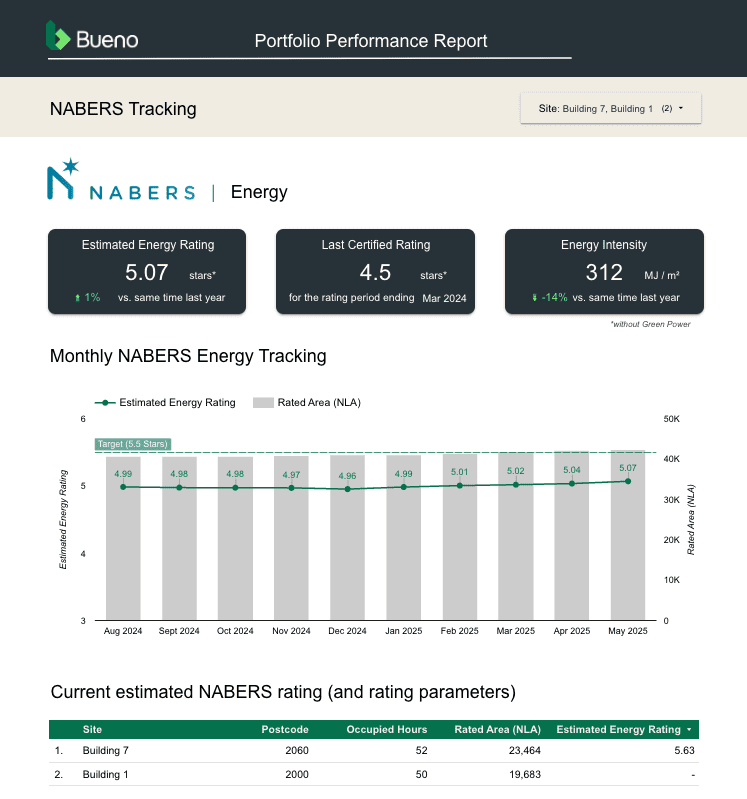
Achieving and maintaining a strong NABERS UK rating is not a one-time exercise — it requires continuous monitoring of how the building is performing between annual assessments. Energy drift, equipment faults, and occupancy changes can all erode performance without being immediately visible.
This is where building analytics platforms play a direct role. By integrating with a building’s existing HVAC, metering, and BMS systems, analytics deliver continuous visibility into the operational signals that determine NABERS outcomes — catching inefficiencies early, validating that fixes have held, and ensuring that performance is maintained, not just achieved once.
At Bueno, we work with property teams across Australia and the UK to support both NABERS Energy ratings and Design for Performance commitments — providing the continuous data layer that turns a one-off certification into a sustained operational outcome.
Summary
BREEAM and NABERS UK are complementary, not competing. BREEAM proves how a building was designed. NABERS UK proves how it performs. For UK property teams navigating the increasing demands of tenants, investors, and regulators in 2026, understanding both — and using each for what it was designed to do — is no longer optional. It is simply how high-performing assets are managed.
Ready to Optimise Your NABERS UK Energy Ratings?
Contact Bueno to discuss NABERS UK tracking, analytics, and AI-assisted rating roadmaps for your UK offices.