
Why Sustainability Ratings Are Becoming Essential for the Hospitality Industry
The hospitality sector is entering a new era of transparency and sustainability. Energy performance is no longer just an operational issue. It is quickly becoming a commercial requirement.
Across Australia, NABERS for Hotels is emerging as the benchmark for measuring and improving the environmental performance of accommodation assets. Government policy, corporate travel requirements, and increasing consumer expectations are driving hotel operators to demonstrate verified sustainability outcomes.
For hotel owners, operators, and asset managers, this shift represents both a challenge and a major opportunity. Hotels that actively manage energy performance can reduce operating costs, strengthen brand reputation, and secure high-value corporate and government bookings.
Understanding NABERS and implementing a clear roadmap to improve ratings will soon be a critical part of running a competitive hospitality asset.
What is NABERS for Hotels
Understanding Australia’s trusted building performance rating
NABERS (National Australian Built Environment Rating System) is a government-backed sustainability rating system that measures the environmental performance of buildings across Australia.
NABERS for Hotels provides a verified rating of operational performance, covering areas such as:
Energy consumption
Water usage
Indoor environment quality
Waste management
Unlike design-based certifications, NABERS focuses on how buildings perform in real operation. Ratings are based on measured energy and operational data rather than theoretical modelling.
The system has been operating for more than 25 years and has become one of the most respected building performance benchmarks globally. The framework helps building owners identify inefficiencies, reduce operational costs, and improve environmental outcomes.
For hotels specifically, NABERS ratings allow operators to demonstrate that their property is delivering sustainable performance while maintaining high levels of guest comfort.
What NABERS Means for the Hotel Industry
Sustainability becoming a competitive requirement
The hospitality industry is highly energy intensive. Hotels operate continuously, with significant demand from guest rooms, kitchens, laundries, conference spaces, pools, and HVAC systems.
At the same time, climate change is increasing pressure on the sector. Rising temperatures, extreme weather events, and growing sustainability expectations from travellers are reshaping how hospitality assets are managed.
NABERS provides a framework that helps the industry address these pressures by creating:
Clear performance benchmarks for energy efficiency
Comparable ratings across competing hotels
Transparency for travellers and corporate customers
Hotels that actively manage their NABERS rating can differentiate themselves in a market where sustainability is increasingly part of the booking decision.

Booking Platforms Will Soon Display NABERS Ratings
Sustainability becoming visible to travellers
One of the most significant policy changes affecting the hospitality industry is the integration of NABERS ratings into government booking systems.
Under the Net Zero in Government Operations Strategy, Australian Government travellers must consider environmental impact when booking accommodation. From July 2024, NABERS Energy ratings will be displayed alongside applicable hotels in government booking tools.
This has important implications:
Hotels with strong ratings will gain visibility in government booking systems
Corporate travel programs are likely to follow similar sustainability policies
Low-performing assets risk losing business from government and ESG-focused organisations
In effect, sustainability performance is becoming part of the commercial selection criteria for accommodation.
How NABERS Supports Australia’s Net Zero Strategy
Policy driving decarbonisation across the built environment
NABERS plays an important role in Australia’s approach to improving energy performance across buildings.
Government policies are increasingly encouraging organisations to consider verified environmental performance when making property and travel decisions.
Several policy initiatives are already influencing the hospitality sector.
Key developments include:
Consultation on expanding the Commercial Building Disclosure (CBD) program to the hotel and accommodation sector
State planning policies such as the NSW Sustainable Buildings SEPP, which requires minimum 4-star NABERS Energy and Water ratings for large hotels
The Net Zero in Government Operations Strategy, which requires Australian Government travellers to consider environmental impact when booking accommodation, with NABERS ratings displayed in government booking tools from July 2024
Together, these initiatives signal a clear shift toward greater transparency in building performance across the hospitality sector.
Hotels that measure and improve their energy performance will be better positioned to meet emerging policy expectations and the growing demand for sustainable accommodation.
Why NABERS is Good for the Hospitality Industry
Lower energy costs and stronger asset value
Beyond compliance, NABERS also delivers tangible financial benefits.
Energy is one of the largest operational costs for hotels. Efficient buildings can significantly reduce utility expenditure while improving operational stability.
Benefits of higher NABERS ratings include:
Lower energy and water costs
Reduced operational waste
Improved asset value
Stronger ESG credentials
Increased attractiveness to corporate and government travellers
Across the broader building sector, NABERS has already delivered significant financial and environmental benefits, including billions of dollars in energy savings and substantial emissions reductions.
For hotels, these gains translate directly into improved operating margins and stronger long-term asset value.

What is Included in the NABERS Rating Process for Hotels
Obtaining a NABERS rating involves a structured assessment process carried out by accredited assessors.
Typical steps include:
Data collection from energy meters and building systems
Operational information about the hotel (rooms, occupancy, services)
Verification of energy usage across building services
Normalisation of performance based on hotel operations
Independent assessment and certification of the rating
The process ensures that ratings are consistent, transparent, and comparable across the industry.
For hotel operators, the rating also provides a valuable benchmark for identifying areas where energy performance can be improved.
How Bueno Analytics Helps Hotels Improve NABERS Ratings
Data-driven optimisation for hospitality assets
Improving a NABERS rating requires more than simply installing efficient equipment. It requires continuous visibility into how building systems are performing.
Bueno Analytics provides hotels with a unified analytics platform that delivers detailed insights across all building systems, helping operators identify energy waste and optimise performance.
The platform focuses on three core capabilities.
Energy Management
Monitor energy usage across guest rooms, kitchens, spas, conference areas and back-of-house operations. High-resolution data enables operators to identify inefficiencies and reduce consumption without affecting guest comfort.
Fault Detection and Diagnostics
Detect issues across HVAC systems, hot water systems, lifts and other critical infrastructure. Early detection allows engineering teams to address performance problems before they affect energy efficiency or guest experience.
Building Optimisation
Advanced analytics and AI help fine-tune building controls, adapt operations to changing occupancy patterns, and ensure systems operate efficiently throughout the day.
By connecting directly to building management systems and utility meters, Bueno provides the visibility needed to support continuous improvement in NABERS performance.
Creating a NABERS Roadmap for Hotels
From baseline measurement to continuous optimisation
Improving a NABERS rating is not a one-off project. Achieving and maintaining strong performance requires a structured roadmap that aligns asset owners, operations teams, engineering teams, and sustainability leaders.
For hotels, this roadmap begins with understanding the current performance of the building and then implementing a continuous improvement strategy that optimises energy use without compromising guest comfort.
A typical NABERS improvement roadmap includes:
• Establishing a verified baseline NABERS rating
• Analysing building data to identify operational inefficiencies
• Prioritising high-impact optimisation opportunities
• Implementing operational and control improvements
• Monitoring results and verifying performance improvements
For hotel portfolios, analytics platforms make it possible to apply this process consistently across multiple properties. Instead of relying on manual analysis or periodic engineering reviews, operators can use advanced analytics to continuously identify where improvements will have the greatest impact.
Moving Beyond Annual NABERS Reviews
Continuous performance monitoring across hotel operations
Historically, many buildings treated NABERS as an annual compliance exercise. Ratings were assessed once per year, often based on retrospective analysis of energy data.
Modern building analytics now allow operators to take a far more proactive approach.
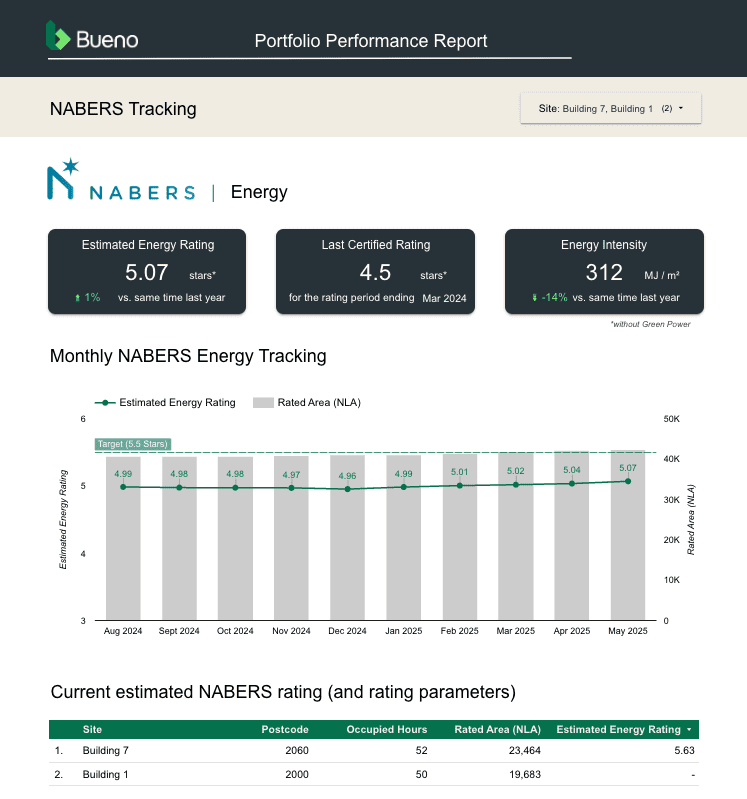
Using near real-time monitoring and predictive insights, hotel engineering teams can continuously track building performance and detect changes that may affect their rating.
This allows operators to:
• Detect energy drift before it impacts the NABERS rating
• Identify faults in HVAC, hot water, and other critical systems
• Track performance trends across seasons and occupancy patterns
• Maintain optimal operating conditions throughout the year
Instead of waiting for an annual review, building performance can now be managed continuously.
Using AI to Generate a NABERS Improvement Roadmap
Bueno Analytics enhances this process by combining building data, advanced analytics, and AI-driven insights to generate a clear roadmap for improving NABERS performance.
Within the Bueno platform, AI tools analyse building data across energy meters, BMS systems, and operational inputs to identify the actions most likely to improve energy performance and NABERS outcomes.
These tools allow engineering and sustainability teams to:
• Automatically identify faults and inefficiencies impacting energy performance
• Quantify potential energy and cost savings from optimisation actions
• Prioritise actions based on their expected impact on NABERS performance
• Track verified improvements over time
Because Bueno collects building data every five minutes, teams gain near real-time visibility into performance trends and optimisation opportunities.
The platform can also surface recommended actions through AI-assisted tools such as Insights Query, allowing operators to ask questions about building performance and generate actionable improvement pathways.
This approach transforms NABERS management from a compliance exercise into a continuous optimisation process.
Instead of relying on static reports, hotel operators can use analytics and AI to maintain performance throughout the year and steadily improve their rating over time.
NABERS is becoming a defining factor for hotel performance
The introduction of NABERS for Hotels marks a significant shift in how hospitality assets are evaluated.
Sustainability performance is moving from a voluntary initiative to a measurable requirement for many government and corporate travellers.
Hotels that embrace NABERS early can benefit from:
• Lower operating costs
• Stronger sustainability credentials
• Improved asset value
• Increased attractiveness to corporate and government bookings
By combining accurate building data with advanced analytics, hotel operators can build a clear roadmap to improve performance and remain competitive in a rapidly evolving hospitality market.
Contact Bueno to learn how building analytics can support your NABERS roadmap and help your hotel improve energy performance, reduce operating costs, and maintain strong sustainability ratings.