
A building management system (BMS) is a computer-based platform that monitors and controls a building's mechanical and electrical systems — including HVAC, lighting, fire safety, and energy metering — from a single supervisory interface. Also known as a building automation system (BAS), it is the foundational layer of control and data collection on which all modern building analytics and optimisation tools are built.
Walk into most commercial buildings built in the last two decades and somewhere, usually in a basement plant room or a facilities manager’s office, there is a Building Management System (or BMS) quietly running in the background. It is controlling the air conditioning, monitoring the boilers, managing lighting schedules, and logging alarm events — all without anyone paying it much attention. Until something goes wrong.
For many building owners and operators, the BMS occupies a strange middle ground: critical enough that no one would run a modern building without one, but poorly understood enough that most organisations significantly underutilise what they have. According to the US Department of Energy, commercial buildings waste approximately 30% of the energy they consume on average — and the building management system sits at the centre of that problem, and its solution.
In a market where energy costs, sustainability obligations, and occupant expectations are all rising simultaneously, that underutilisation is becoming increasingly expensive. This article explains what a building management system is, how to get it right from the start, what the most common pitfalls look like in practice, when it makes sense to upgrade, and why the relationship between a BMS and analytics is now the most important question in building operations.
What a Building Management System Actually Is
A building management system monitors and controls the mechanical and electrical systems within a building. At its most basic, it brings HVAC, lighting, fire safety, security, and energy metering under a single supervisory layer, allowing those systems to communicate, coordinate, and be managed from a central interface.
The architecture of a Building Management System typically operates across three levels. At the field level, sensors and actuators collect data and execute commands — a temperature sensor reading the air in a zone, a valve actuator adjusting flow, a damper responding to a setpoint. At the control level, field controllers process that data and implement logic locally, maintaining conditions within defined parameters. At the supervisory level, the BMS software presents a unified view of building performance, enables scheduling and setpoint management, generates alarms, and provides the data layer that reporting and analytics tools connect to.
The protocols that allow these layers to communicate — the languages devices use to exchange information — are one of the most consequential decisions in any BMS deployment. Open, standardised protocols allow equipment from different manufacturers to work together and create a data foundation that third-party analytics platforms can access without dependency on any single vendor. Proprietary or closed protocols do the opposite: they work within a specific ecosystem but create barriers that make future integration, upgrades, and analytics connectivity significantly more difficult and expensive.
This distinction matters enormously. A building with a well-structured, open-protocol BMS is a building that can be analysed, optimised, and improved over time. A building locked into a closed or poorly configured BMS is one where data sits inaccessible, where adding new capabilities requires ripping out what exists, and where the cost of doing anything meaningful with the building’s operational data is prohibitively high.
Best Practice in BMS Deployment
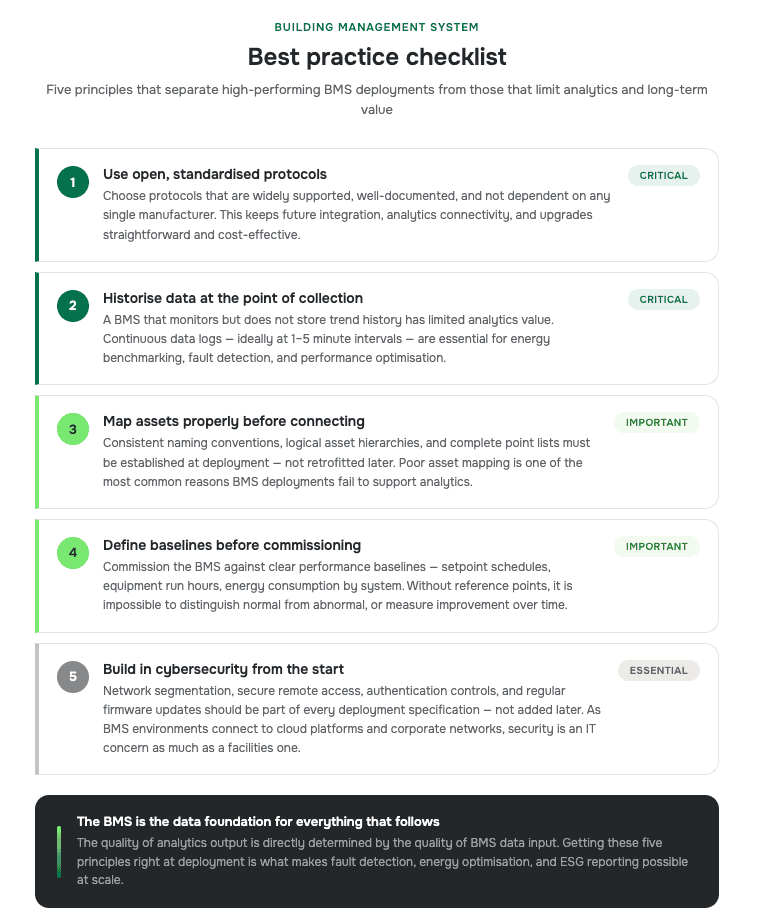
Whether implementing a new Building Management System or connecting an existing system to analytics, there are principles that consistently separate deployments that deliver long-term value from those that create ongoing operational headaches.
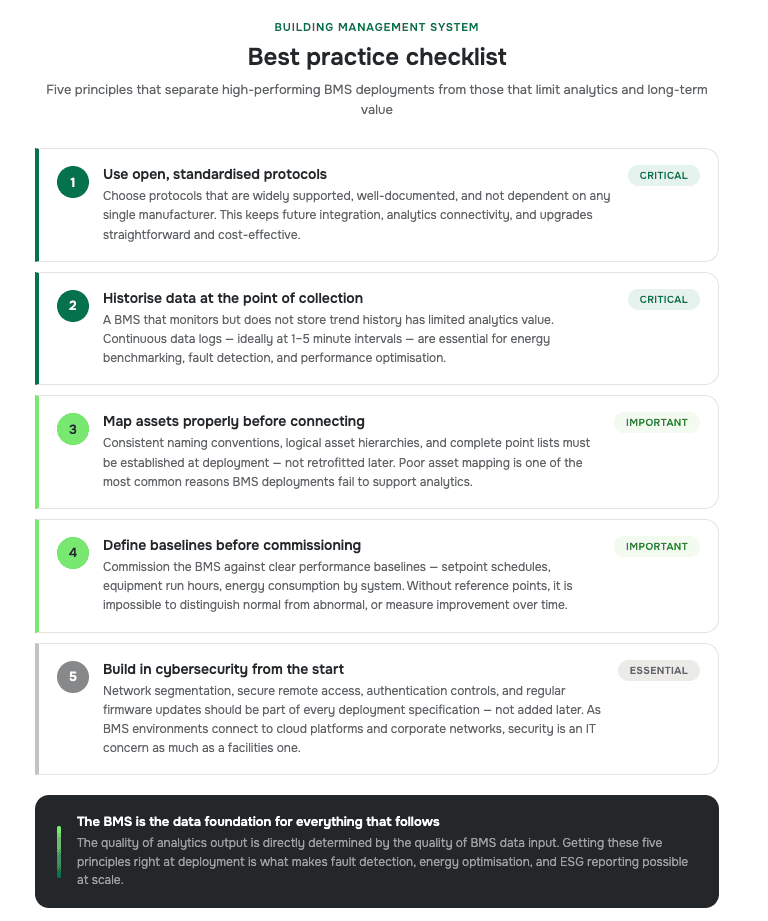
Prioritise open, standardised protocols from the outset. The most reliable path to a flexible, analytics-ready building is a BMS built on protocols that are widely supported, well-documented, and not dependent on any single manufacturer’s ongoing cooperation. Systems built this way are straightforward to integrate with, can accept data from multiple sources, and remain accessible as technology evolves.
Ensure data is historised at the point of collection. A BMS that monitors values but does not store trend history is of limited value for analytics. For any meaningful analysis — energy benchmarking, fault detection, performance optimisation — a continuous record of how building conditions have changed over time is essential. This should be a baseline requirement, not an afterthought.
Map the building properly before connecting anything. Poor asset naming, inconsistent tagging, and incomplete point lists are among the most common reasons BMS deployments fail to deliver value. If the system does not know which sensor belongs to which piece of equipment, which equipment serves which zone, and which zone maps to which floor and tenancy, the data it produces is difficult to interpret and nearly impossible to analyse at scale. Proper naming conventions and logical asset hierarchies should be established at deployment, not retrofitted later.
Define what “good” looks like before commissioning. A BMS should be commissioned against clear performance baselines — setpoint schedules, equipment run hours, energy consumption by system. Without these reference points, it is impossible to distinguish normal from abnormal, or to measure whether the system is actually delivering the efficiency outcomes it was designed for.
Treat cybersecurity as a non-negotiable, not an add-on. As building systems become more connected — to cloud platforms, remote monitoring tools, and corporate IT networks — the security of the BMS becomes an IT concern as much as a facilities one. Network segmentation, secure remote access, authentication controls, and regular firmware updates should all be part of the deployment specification.
The Most Common Pitfalls
Even well-intentioned Building Management System deployments regularly fall into the same traps. Understanding them is the first step to avoiding them.
Alarm fatigue. A BMS that generates hundreds of alarms a day — many of which are low-priority, recurring, or poorly configured — trains operators to ignore them. When the system flags everything, nothing gets attention. The result is that genuine faults and performance issues sit unaddressed while operators learn to dismiss notifications as background noise. This is one of the most pervasive problems in building operations and one of the strongest arguments for analytics-based fault detection that prioritises issues by impact rather than generating raw alarm volumes.
Vendor dependency. Buildings whose BMS is configured in a way that requires the original installer or manufacturer to make any meaningful change — add new points, update setpoints, modify control sequences — are operationally fragile and commercially exposed. When the relationship with that contractor changes, or when the technology reaches end of life, the cost of transition can be enormous.
Data that no one can read. Logged data in a format that only the BMS’s own interface can interpret — proprietary, unexported, inaccessible via standard methods — is not an asset. It is information that exists but cannot be used. Analytics platforms, ESG reporting tools, and portfolio management systems need data they can actually access.
Systems that were never recommissioned after installation. A BMS commissioned in a building’s first year of operation rarely reflects how that building is actually used by year five. Occupancy patterns change, tenancies turn over, equipment ages, control sequences drift. Without periodic recommissioning, the gap between what the system thinks is happening and what is actually happening widens continuously.
Underestimating integration complexity. Not all BMS environments are equally accessible. Some systems, particularly older or more proprietary platforms, require significant additional work before they can be reliably connected to analytics or third-party tools. This is not always apparent at the point of sale, and surprises during deployment are costly. Understanding the integration profile of an existing BMS before committing to an analytics program is essential.
Understanding BMS Protocols — and What to Look Out For
A building management system is only as useful as the data it can share. The protocol a Building Management System uses — the language by which its devices communicate with each other and with external platforms — determines whether that data is accessible, structured, and reliable enough to support analytics. For property and facilities teams evaluating a new BMS or connecting an existing one to an analytics platform, understanding protocols is not a technical curiosity. It is a procurement decision with long-term financial consequences.
The protocol landscape
There are four protocol families you are most likely to encounter in commercial building environments today.
BACnet (Building Automation and Control Networks) is the dominant open standard for commercial building automation globally, maintained by ASHRAE. Its key advantage for analytics is that it is not simply a transport layer — it models building data as objects with defined properties, which means a device’s data points are semantically described, not just numbered registers. An analytics platform connecting to a BACnet system knows what it is reading: a temperature sensor is a temperature sensor, not register 4019. This semantic structure dramatically reduces integration effort and makes large-scale, multi-site deployment significantly faster. BACnet over IP (BACnet/IPv4) is the current best-practice implementation for most commercial deployments.
Modbus is one of the oldest and most widely deployed industrial protocols. It is simple, robust, and available on an enormous range of devices — energy meters, chillers, variable speed drives, and field controllers all commonly support it. Its limitation from an analytics perspective is that it has no semantic layer: data is accessed by register number, and what that register means is only defined in a manufacturer-specific register map document. Integrating Modbus devices into an analytics platform requires careful manual mapping of every point, which adds integration time and creates maintenance overhead when devices or firmware versions change. Modbus is most valuable as a field-level protocol for specific equipment rather than as the primary supervisory layer.
LonWorks was once widely deployed in commercial buildings, particularly in the 1990s and 2000s, and remains present in a significant portion of the existing global building stock. It requires specialised hardware and expertise that has become increasingly scarce, and it has no meaningful path to modern cloud or analytics integration without a gateway device translating it to a more accessible protocol. For new deployments it should not be specified; for existing buildings that still run LonWorks at the field level, a gateway to BACnet or a direct API integration at the supervisory level is the standard approach.
API-based integration sits alongside traditional field protocols and is increasingly important as major BMS platforms expose their data through cloud APIs and web services. Well-documented, stable APIs can be an excellent integration path — they typically provide clean, structured data without requiring physical access to the network. The risk is variability in quality: some vendor APIs are robust, well-maintained, and suitable for large-scale deployment; others suffer from rate limitations, inconsistent data quality, or licensing models that charge per data point or per connection refresh. Before committing to an API integration path, it is worth understanding the vendor’s roadmap, their licensing model, and whether the API supports the data resolution and backfill capability your analytics platform requires.
The question to ask
When evaluating a Building Management System or an integration path, the most useful single question is: can a third party connect to this system, access its historical data, and receive new data at the resolution we need, without requiring the original vendor’s involvement or incurring additional licensing costs?
If the answer is yes, you have a solid foundation for analytics. If the answer involves qualifications, exceptions, or cost discussions with the BMS vendor, that is the risk to understand and price before committing.
Future-Proofing: What It Actually Means
Future-proofing a BMS is not about buying the most advanced system available today. It is about making decisions that preserve optionality — that keep the building’s data accessible, the system’s architecture adaptable, and the organisation’s choices open as technology evolves.
In practice this means favouring open protocols over proprietary ones, insisting on documented and accessible APIs, maintaining comprehensive asset records and naming conventions, and avoiding configurations that create hard dependencies on any single vendor or technology stack.
It also means recognising that the value of a BMS is increasingly determined not by what it controls, but by the quality of data it produces. A building whose BMS generates clean, structured, accessible, high-resolution data is a building that can benefit from every generation of analytics and AI tools that follows. A building that does not is one that will need to solve the same integration problems repeatedly, at increasing cost, as the technology landscape moves on.
What to look out for
Proprietary or undocumented implementations. A system that uses a standard protocol name but implements it in a non-standard or proprietary way can be just as difficult to integrate with as a fully closed system. The test is whether a third-party device or platform can connect to it without requiring the original manufacturer’s involvement. If the answer is no, or if the manufacturer charges a licensing fee for third-party connectivity, that is a significant integration risk.
Protocol version and capability mismatches. Not all BACnet implementations are equal. Older versions may not support the features — particularly historisation, change-of-value reporting, and trend logging — that analytics platforms depend on. Similarly, a Niagara-based supervisory platform may be running a version that does not support the integration module an analytics vendor requires. Version compatibility should be confirmed before deployment, not discovered during it.
Data resolution limitations. Even where a protocol connection is technically possible, the underlying controller may only log data at 15-minute or hourly intervals, or may only retain a limited number of trend records before overwriting them. Analytics platforms typically need data at 1–5 minute resolution to perform meaningful fault detection and energy analysis. A protocol connection that only delivers low-resolution data is a connectivity success but an analytics failure.
Indirect or gateway-dependent paths. Some integrations require a chain of protocol translations — field device to local controller, local controller to supervisory system, supervisory system to analytics platform — with each step introducing potential points of failure, latency, or data loss. Understanding the full data path from sensor to analytics is important, not just the first or last link in the chain.
Vendor lock-in by configuration, not protocol. A system may use an open protocol but be configured in a way that prevents meaningful third-party access — point naming that is undocumented, access credentials held only by the installing contractor, or network segmentation that blocks external connections. Open protocol compliance is necessary but not sufficient; the configuration and access model matters equally.
The Relationship Between a BMS and Analytics
This is where the stakes of getting a BMS right become most visible.
HVAC systems alone account for approximately 40% of total energy consumption in the average commercial building — making them the single largest operational cost driver in most portfolios. Yet the majority of buildings have no reliable way to know whether those systems are running efficiently day to day, or whether performance has quietly degraded since last year’s maintenance visit.
A building management system is fundamentally a control and monitoring platform. It keeps conditions within defined parameters and alerts operators when something falls outside them. What it does not do — what it was never designed to do — is interpret what those conditions mean, identify the root cause of performance problems, prioritise which issues to address first, or quantify the financial and environmental impact of what it is observing.
That is the role of analytics.
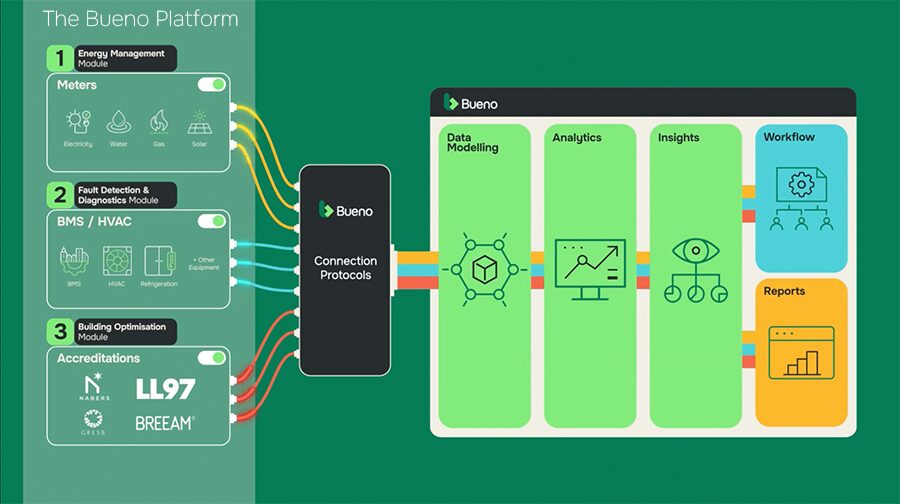
Analytics platforms connect to the data a BMS generates and apply the intelligence layer that turns raw readings into actionable insight. They identify patterns that indicate equipment degradation before failure occurs. They detect the operational signatures of energy waste — systems running when they should not be, equipment fighting itself, setpoints drifting outside acceptable ranges. They prioritise issues by impact rather than severity of alarm. And they provide the continuous visibility into building performance that periodic audits and manual inspections simply cannot match.
But analytics can only be as good as the data they receive. A BMS that logs infrequently, names assets inconsistently, restricts data access, or produces unreliable readings provides a poor foundation regardless of how capable the analytics layer is. The quality of what comes out is determined by the quality of what goes in.
This is why the BMS is not simply an infrastructure decision — it is the foundational data decision for everything that follows. Organisations that treat it as such, and invest accordingly in deployment quality, data structure, and integration capability, are the ones that realise the full value of the analytics tools they subsequently connect to it.
At Bueno, we connect to building management systems across a wide range of environments, ages, and configurations. Our experience has given us a clear picture of what separates deployments that enable powerful analytics from those that limit it — and we have built our deployment approach around making that distinction visible before a project begins, not after.
To learn more about how Bueno connects to building management systems and what analytics can deliver on top of your existing infrastructure, visit our Fault Detection & Diagnostics, Energy Management, and Building Optimization pages, or speak to our team.