
What is DDM – Data Driven Maintenance?
DDM – Data Driven Maintenance is a modern maintenance strategy that uses continuous building data to determine when maintenance is actually needed. Instead of repairing equipment when it fails (reactive) or according to a fixed calendar (preventive), DDM ensures maintenance happens at the optimal moment based on equipment behaviour, performance drift, and operational impact.
In the global market, DDM is also known as:
• CBM – Condition-Based Maintenance (UK / Europe)
• PdM – Predictive Maintenance (North America)
• Smart Maintenance (Asia)
• APM – Asset Performance Management (Investment & REIT language)
Regardless of naming, the concept is the same: use real building data to direct maintenance with accuracy and speed.
How DDM – Data Driven Maintenance Works in the Built Environment
DDM – Data Driven Maintenance is rapidly becoming a defining capability in the building analytics sector. It represents the shift from traditional maintenance practices—reactive, schedule-based, and labour-heavy—to a modern, intelligence-led model where decisions are guided by real operational data.
In the built environment, DDM – Data Driven Maintenance is essentially the productisation of the “Data-to-Action” loop. Instead of relying on physical inspections or a 3-monthly PPM schedule, DDM creates a continuous, digital feedback cycle that ensures maintenance resources are deployed only when required and at the moment of maximum impact.
This loop is made up of five critical stages.
1. Continuous Data Collection
Modern buildings are filled with real-time data sources—HVAC sensors, pumps, AHUs, submeters, BMS points, environmental sensors and more. DDM systems continuously ingest this telemetry to create a live view of equipment performance and building behaviour.
Instead of occasional snapshots captured during site visits, operators gain a never-ending stream of condition data, feeding the maintenance strategy every five minutes.
2. Automated Detection of Drift, Degradation and Fault Patterns
Once the data is captured, analytics engines—driven by rules, pattern detection and machine learning—identify issues such as:
• energy waste
• control faults
• equipment degradation
• valve and damper failures
• sensor inaccuracies
• run-time anomalies
This step is traditionally described as Fault Detection & Diagnostics (FDD), and it is essential for enabling DDM. FDD tells us what is happening and why it is happening, long before the fault is visible in the field.
3. Intelligent Decision-Making: Triage, Severity and Priority
DDM – Data Driven Maintenance goes beyond identifying faults. It evaluates each issue to determine:
• Impact – Is this wasting energy? Causing comfort issues? Degrading equipment?
• Severity – Is this urgent or non-critical?
• Timing – Does the issue require immediate action or can it be scheduled?
• Cost-Benefit – Is it worth sending a technician now, or should it be batched with other tasks?
This step converts raw technical insight into operational intelligence, ensuring that every work order aligns with portfolio priorities, budgets and labour availability.
4. Technician Execution with Clear, Data-Backed Instructions
Based on the triage logic, the platform generates a targeted work order that includes:
• the exact equipment affected
• the diagnostic evidence
• recommended corrective action
• the estimated impact on performance or energy
• the urgency of the task
Instead of “investigate AHU”, a technician sees a clear instruction such as:
“Main cooling valve is stuck at 38% causing 19% excess energy waste. Prioritise within 48 hours.”
This precision eliminates wasted labour time, improves first-time fix rates and reduces dependency on scarce expert technicians.
5. Verification Through Live Data
Once the work is completed, the platform verifies the result by analysing post-work telemetry:
• Has the fault cleared?
• Has the performance drift stabilised?
• Has the energy signature improved?
• Has the equipment returned to normal operation?
This is a crucial differentiator: maintenance actions are proven, not assumed.
The loop closes, and the system continuously builds a more accurate understanding of equipment behaviour and maintenance impact.
Why the Market Is Moving Toward DDM – Data Driven Maintenance
DDM is not a technology trend—it is a market necessity. Buildings are becoming more complex, regulations are tightening, and portfolios are under growing pressure to reduce carbon emissions, improve tenant experience and contain operational costs.
Here are the key forces accelerating DDM adoption globally:
1. ESG & Carbon Reduction Pressures
Building owners must produce evidence of reducing energy waste and improving equipment efficiency. DDM eliminates silent failures, unnecessary energy losses and performance drift—directly supporting decarbonisation frameworks such as NABERS, GRESB, CRREM and LL97.
2. Labour Shortages and Skills Gaps
The facility management workforce is ageing, and experienced technicians are retiring faster than the industry can replace them.
DDM enables:
• less reliance on deep specialist knowledge
• faster issue triage
• better use of limited labour resources
This is essential for portfolios struggling to maintain service levels.
3. CapEx Deferral and Asset Longevity
Replacement costs for HVAC and mechanical equipment continue to rise.
DDM extends asset life by addressing degradation early and reducing run-time stress—meaning owners can postpone expensive upgrades and stabilise long-term capital planning.
4. Rising Operational Costs
Energy costs, contractor callouts and reactive maintenance all place financial pressure on property owners.
DDM reduces:
• waste
• emergency callouts
• overtime costs
• unnecessary PPM tasks
5. Tenant Expectations
Tenants increasingly expect stable comfort, low noise, reliable air quality and modern building performance. DDM supports consistent environmental conditions by keeping equipment stable, tuned and fault-free.
Outcome
DDM transforms maintenance from an unpredictable cost into a measurable, strategic efficiency engine.
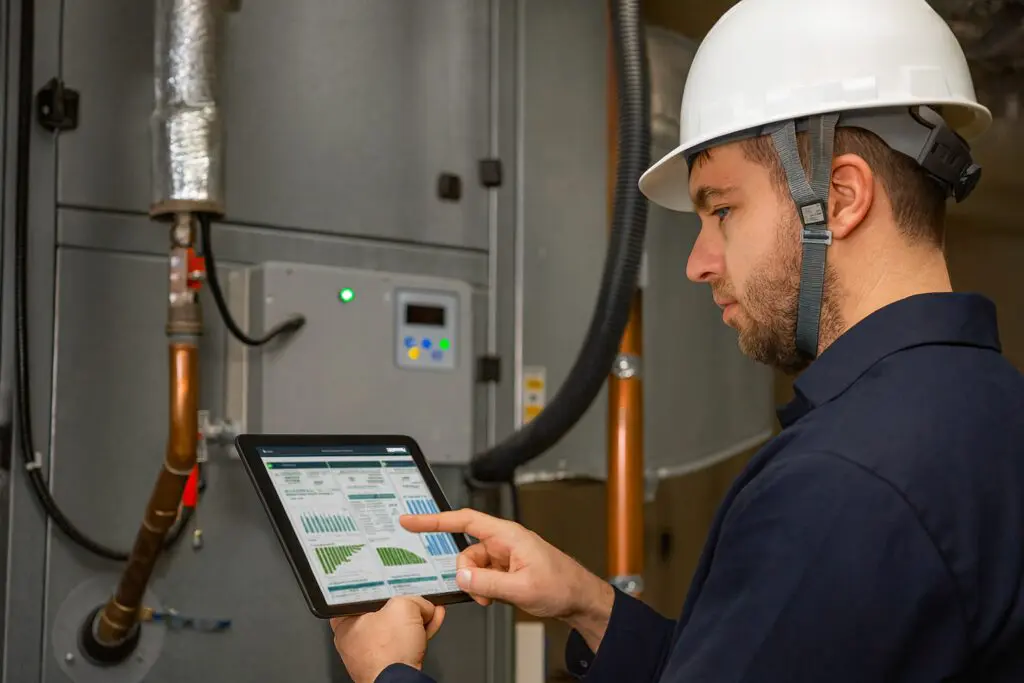
The Bueno DDM – Data Driven Maintenance Solution – Powered by FDD & Continuous Data
Bueno delivers a true DDM solution built for large property portfolios:
1. Near Real-Time Equipment Monitoring (5-minute intervals)
• Detects drift and inefficiencies early
• Ensures issues are caught before failure
2. Automated Triage & Action Pathways
• Critical / high / low priority
• Clear maintenance tasks based on real data
• Eliminates vague “look into this” work orders
3. Smart Maintenance Timing
• Replace only when required
• Avoid rushed, reactive callouts
• Reduce expensive overtime labour
4. Cost-Focused Decisioning
• Only dispatch contractors when justified
• Reduce unnecessary PPM tasks
• Cut energy waste and asset wear
5. Verification Loop
• Confirms the issue is resolved
• Measures improvement
• Supports continuous ROI visibility
6. Portfolio-Wide Visibility
• Compare asset performance across all sites
• Identify systemic maintenance patterns
• Strategically reallocate maintenance budgets

The Bueno DDM Solution – From Detection to Action to Measurable Outcomes
Implementing DDM – Data Driven Maintenance requires more than fault detection alone. It demands a connected process that turns equipment data into clear priorities, targeted maintenance actions and verified operational improvements. This is where Bueno’s approach stands out.
Bueno’s DDM solution addresses the four biggest maintenance challenges faced by modern property teams—excessive scheduled maintenance, slow reaction times, hidden failures, and rising energy waste—by transforming raw telemetry into actionable, high-impact workflows.
1. Reducing Excessive PPM and Unnecessary Callouts
Most buildings still rely on Preventative Planned Maintenance (PPM) regardless of actual need—changing filters, inspecting valves, or servicing pumps on a calendar rather than based on condition. This creates unnecessary truck rolls, increased labour hours and wasted operational budget.
How Bueno solves this:
• Continuous equipment monitoring reveals which assets truly require intervention
• Maintenance schedules are adjusted based on evidence, not guesswork
• Low-impact or non-critical issues can be bundled or deferred
• Teams focus only on what matters, when it matters
The outcome:
Significant reduction in labour hours, contractor costs and unnecessary site visits. Maintenance becomes a controlled, predictable expense rather than a default routine.
2. Eliminating Slow, Reactive Repair Cycles
Traditional repair workflows involve vague BMS alarms, incomplete information and lengthy diagnosis, often requiring multiple site visits before the real issue is found.
How Bueno solves this:
• Automated triage ranks every issue by severity, risk and impact
• Maintenance tasks arrive with precise diagnostics and recommended action
• Technicians know exactly what is wrong before they arrive
• The process eliminates “diagnosis on the clock” and avoids unproductive visits
The outcome:
Faster response times, higher first-time fix rates and greater operational stability across the portfolio.
3. Preventing Hidden Failures and Performance Drift
Many equipment issues do not cause immediate operational problems. Instead, they silently degrade performance—passing valves, stuck dampers, faulty sensors, inefficient run-times. These issues often go undetected for months.
How Bueno solves this:
• Near real-time analytics detect behaviour changes the moment they occur
• Drift, degradation and anomalies are highlighted early
• Operators can intervene before comfort issues or failures arise
• Equipment lifespan is extended through timely maintenance
The outcome:
Improved uptime, fewer breakdowns, reduced comfort complaints and longer-lasting mechanical equipment.
4. Tackling Rising Energy Waste and Carbon Impact
Poorly performing equipment often operates inefficiently, driving up energy bills and emissions. This impacts both operational budgets and sustainability performance.
How Bueno solves this:
• The system pinpoints energy-impacting faults and quantifies their cost
• Maintenance actions are prioritised based on energy waste reduction
• Optimisation pathways improve control strategies post-maintenance
• Teams can verify reductions through live energy trends
The outcome:
Lower energy use, reduced emissions and improved performance for frameworks like NABERS, GRESB and LL97.
Where DDM Sits Relative to FDD and True Building Optimisation
Understanding the difference between FDD, DDM and Building Optimisation is essential for explaining why Bueno’s platform outperforms stand-alone fault-detection tools and basic analytics systems. These three layers represent a maturity curve. Each layer builds on the last, but none can replace the other. Most vendors operate only at the bottom of the curve; Bueno delivers all three.
FDD – Fault Detection & Diagnostics
The Tool: Technical Insight
FDD is the analytical engine that scans building telemetry and identifies underlying problems or abnormal behaviour. It answers the technical questions:
• What is broken?
• Where is the issue occurring?
• How severe is it?
• Why is this behaviour abnormal? (root-cause logic)
FDD provides the diagnostic foundation that makes data-driven operations possible.
FDD Output: An Insight
But an insight alone does not improve building performance. Someone must interpret it, prioritise it, and act.
This is where many analytics platforms stop—delivering lists of faults without a pathway to action. The result is alert fatigue, missed issues and inconsistent outcomes.
DDM – Data Driven Maintenance
The Strategy: Operational Execution
DDM is the layer that operationalises FDD insights. It converts technical diagnostics into clear, structured and prioritised maintenance workflows.
DDM answers a different set of questions:
• What should we do about this insight?
• How urgent is it?
• Who should action it?
• When is the optimal time to perform the work?
• What is the cost-benefit of intervening now?
It is the difference between “The valve is leaking” and:
“This leaking valve will cost $620/month in wasted energy. Prioritise within 48 hours. Assign to Contractor X.”
DDM ensures maintenance investment is aligned with operational impact—not guesswork or calendar-based routines.
DDM Output: An Action
This is the point where building performance begins to materially improve, because maintenance becomes deliberate, precise and verified.
However, DDM is still focused on equipment condition—one asset at a time.
It does not yet reshape overall building operation. That is the next step.
Building Optimization
The Outcome: Whole-Building Performance Improvement
Building Optimisation is a step above DDM. It shifts the goal from fixing equipment to improving how the entire building operates as a system.
While DDM ensures assets are maintained efficiently, Optimisation ensures the building delivers lower energy use, better comfort, improved sequencing and consistent long-term performance.
Optimisation answers a third category of questions:
• How should the building operate at its best?
• Are the control strategies optimal?
• Is the HVAC sequencing efficient across seasons?
• How do comfort, airflow and energy interact?
• What persistent behaviours are inflating energy use?
• How do we stabilise energy drift across the year?
This is where measurable sustainability gains are unlocked.
Optimisation capabilities include:
• tuning HVAC control logic and setpoints
• re-sequencing equipment to reduce load
• removing energy drift and unnecessary run-hours
• balancing comfort conditions
• improving NABERS performance
• reducing emissions across the asset lifecycle
• verifying improvements through 5-minute data
Optimisation sits above both FDD and DDM. It uses the maintenance foundations created by DDM to deliver sustained, systematic, portfolio-level uplift.
Optimisation Output: Sustained Performance Improvement
This is the highest-value part of the Bueno platform.
The Relationship Summarised
FDD → DDM → Optimisation
A continuous progression from detection to action to building-wide excellence.
FDD tells you what’s wrong
DDM tells you what to do about it
Optimisation ensures the whole building runs better afterwards
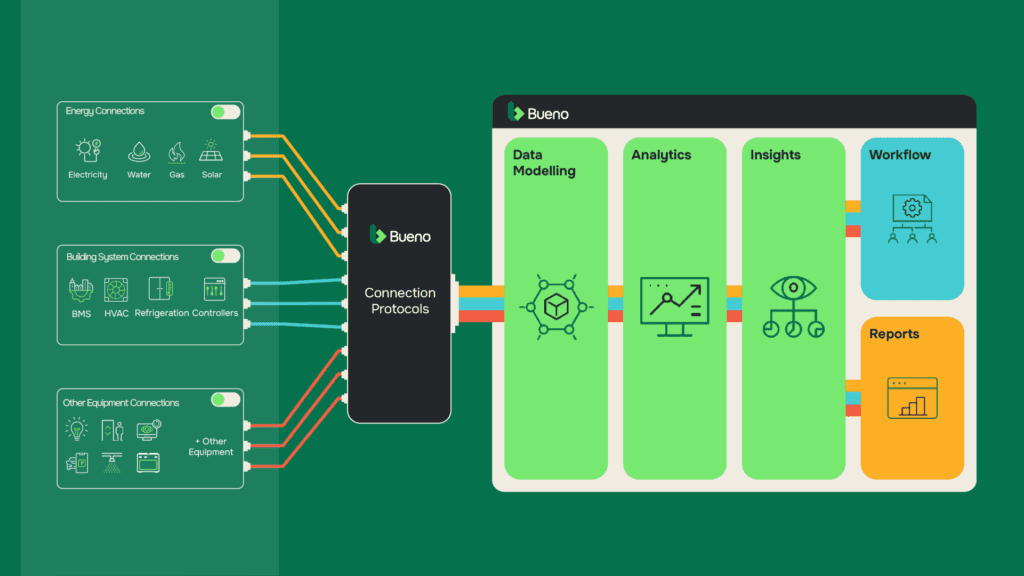
Why This Matters — And Why It Is a Bueno Advantage
Many analytics vendors stop at FDD. A smaller number offer limited versions of DDM (usually simple ticketing). Very few deliver true system-level optimisation.
The Bueno platforms globally delivers all three layers in a single integrated workflow.
That means:
• Issues are detected (FDD)
• Prioritised and resolved (DDM)
• And the building is continuously improved (Optimisation)
This closed-loop approach delivers better outcomes for asset managers, facility managers, ESG teams and tenants—and it directly reduces energy usage, emissions and OPEX across entire portfolios.
Turn insights into action. Turn action into performance.
Speak with Bueno to see how DDM – Data Driven Maintenance and building optimisation can deliver measurable value—from fewer callouts and smoother operations to lower energy use and higher sustainability outcomes.

 English (Australia)
  English
  English (UK)
  Français