
Data Driven Maintenance (DDM) for Commercial Buildings
Spend maintenance hours where the data says they're needed.
Data driven maintenance (DDM) uses continuous building data to decide what needs maintaining, when and in what order, so teams spend less time on planned work that isn’t needed and more time on real faults. Bueno’s fault detection and diagnostics (FDD) finds the faults. DDM then ranks them, gives your team clear instructions and confirms each fix worked. Your team or contractor makes every change.
Also known as: DDM is called condition based maintenance (CBM) in the UK and Europe, predictive maintenance (PdM) in North America, smart maintenance in Asia, and asset performance management (APM) in investment and real estate investment trust (REIT) language. The concept is the same.
AT A GLANCE
22%
5 min
180
Any BMS
KEY FACTS
Key facts about data driven maintenance
- DDM replaces calendar based and reactive maintenance with work driven by equipment condition, ranked by cost, impact and urgency.
- FDD is the engine inside DDM. FDD finds what’s wrong and why. DDM decides what to do, who does it and when, then confirms the result.
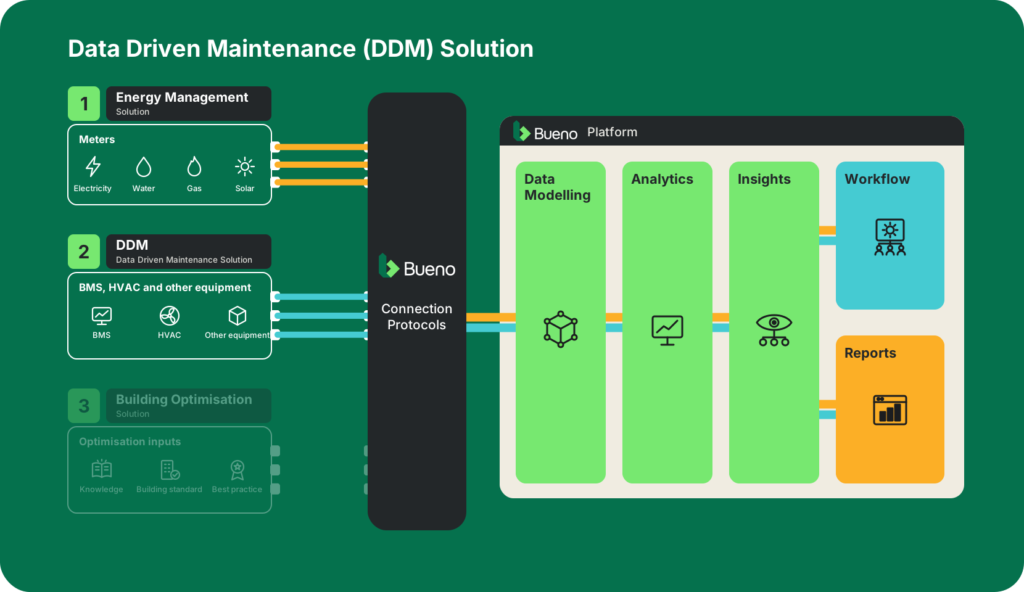
- Data from meters and any building management system (BMS) is analysed near real-time, every 5 minutes, using 180 rules.
- Statutory and safety critical maintenance keeps running to schedule. DDM adjusts the discretionary tasks.
- It works with existing BMS, computerised maintenance management systems (CMMS) and contractor systems, so nothing is replaced.
- Bueno finds, prioritises and recommends. Your team or contractor makes every change, and Bueno never controls equipment automatically.
- DDM is the second of three Bueno solutions: Energy Management, DDM and Optimisation.
What is data driven maintenance (DDM)?
Global Definitions
Why does planned preventive maintenance need to change?
| Approach | What Triggers the Work | Where It Falls Short |
|---|---|---|
| Reactive | A breakdown or a complaint | Problems are found after the disruption |
| Planned Preventive (PPM) | The calendar | Visits to healthy equipment, while faults between visits go unseen |
| Data Driven (DDM) | Measured equipment condition | Needs reliable data and a working maintenance process |
DATA DRIVEN MAINTENANCE OUTCOMES
What Outcomes Does Data Driven Maintenance (DDM) Deliver?
Data Driven Maintenance (DDM) reduces planned work that isn’t needed, finds faults before tenants notice them and gives your team and contractors one prioritised list. It builds on Energy Management and is the first step toward Optimisation. Select a solution below to see how the outcomes build.

How does data driven maintenance work?
Collect
Bueno ingests data from HVAC sensors, pumps, air handling units, sub-meters and BMS points, every five minutes, instead of occasional snapshots from site visits.
Detect
Rules, pattern detection and machine learning pick out drift, degradation and faults such as energy waste, control faults, valve and damper failures and sensor errors. This stage is fault detection and diagnostics (FDD).
Triage
Each issue is assessed for impact, severity, timing and cost benefit, and ranked by cost, impact, urgency and equipment criticality. Low priority issues can be bundled or deferred.
Act
A work order goes to your team with the equipment, the evidence, the recommended action, the estimated impact and the urgency. Related faults can be grouped into one visit.
Verify
After the work, the data shows whether the fault cleared, the drift stabilised and the equipment is back to normal. Maintenance is proven, not assumed.
The loop closes, and the platform keeps building a more accurate picture of equipment behaviour and maintenance impact.
How much planned maintenance can DDM remove?
What stays
- Statutory tasks
- Safety critical tasks
- Compliance tasks
What changes
Discretionary tasks on equipment that data shows is running well can be reduced, bundled or deferred. Time on equipment that isn't running well goes up.
How it's measured
- Planned tasks avoided or deferred
- Technician hours redeployed to real faults
- Repeat faults after a fix
How it typically starts
Run DDM alongside the current program
Use the evidence to adjust schedules
Keep reviewing as the data builds
Maintenance standards
Australia
Works alongside standards like AIRAH DA19.
United Kingdom
Works alongside standards like SFG20.
How does fault detection and diagnostics (FDD) fit inside DDM?
FDD
Tells you what's wrong
This solution
Tells you what to do about it
Makes the whole building run better
What the FDD engine includes
- Multi-layered detection using rules, pattern detection and machine learning, with root cause diagnostics
- Hundreds of proven rules across the platform, 180 in DDM including the Energy Management rules
- Criticality aware analytics that rank faults by cost, impact and urgency
- Portfolio view and asset detail, with scorecard metrics and quick wins
- Alerts customised by region, building type and team
What you get
FDD identifies the problem. DDM directs the maintenance response. Building Optimization improves overall building performance.
How does DDM speed up repairs, catch hidden failures and cut energy waste?
Slow, reactive repair cycles
Hidden failures and performance drift
Energy waste and carbon
WHY NOW
Why is the market moving toward DDM?
ESG and carbon pressure
Labour shortages
Deferred capital spending
Rising operating costs
Tenant expectations
How Does Data Driven Maintenance (DDM) Help Improve Building Performance and Ratings?
Data Driven Maintenance (DDM) is the first step to improving building performance and reducing emissions. DDM reduces energy use by approximately 15% – 20%, and Optimisation is where the biggest improvements happen. Bueno doesn’t rate or certify buildings. Bueno tracks performance and provides roadmaps, so your team and your rating body can act on them.
Energy Management
Track
Tracks energy performance and ratings, including monthly NABERS tracking.
DDM, the first step
Fix the Faults
Finds and fixes the faults that waste energy, reducing energy use by 16%.
Optimisation
Lift Performance
Where the biggest improvements happen, with roadmaps to improve performance and ratings.
Ratings and Regulations That Reward Energy Performance
Australia and New Zealand
National Australian Built Environment Rating System (NABERS). Green Star is a Green Building Council of Australia scheme, also used in New Zealand.
United Kingdom
Building Research Establishment Environmental Assessment Method (BREEAM). Energy Performance Certificates (EPC).
United States
Leadership in Energy and Environmental Design (LEED). Local Law 97 (LL97) and Building Emissions Reduction and Disclosure Ordinance (BERDO) are emissions regulations rather than ratings.
Investor Benchmark
GRESB
The Global Real Estate Sustainability Benchmark (GRESB) scores portfolios, not individual buildings. Participants receive a score out of 100 and a star rating from 1 to 5 against their peers, based on the ESG data they report. Energy and emissions data from Bueno supports that reporting.
Which Bueno solution should I start with?
Energy Management
See It
Trusted energy and water data from meters and sub-meters, 40 rules.
Start here if you don't yet trust your data or need ratings tracking and reporting.
DDM
Fix It
Faults found, ranked, assigned and verified, using meters and BMS data, 180 rules including Energy Management.
Start here if maintenance cost and faults are the problem.
Optimisation
Improve It
Whole building performance and ratings, held over time, using meters, BMS and other equipment such as lights, lifts, fire panels and Internet of Things (IoT) devices, 350+ rules including DDM.
Start here if you have energy and rating targets.
Each solution includes the one before it.
AI & INNOVATION
AI IN DATA DIVEN MAINTENANCE
FAQ
How Does AI Improve Data Driven Maintenance (DDM)?
Artificial intelligence (AI) helps commercial real estate (CRE) teams detect faults, rank them and group the work, so technicians spend less time on false alarms and more time fixing the real problem. AI recommends and your team decides, and your team or contractor makes every change.
Advanced Rule Library
Hundreds of proven rules across the platform, 180 in DDM, detect complex issues across building systems.
AI Fault Triage
Machine learning pools and prioritises faults, reducing noise and guiding technicians to root causes.
Smart Dispatching
AI groups and ranks tasks for efficiency, improving first time fix rates.
Continuous Learning
Models refine detection accuracy with every new fault, enhancing system reliability.
The result: fewer false alarms, faster resolutions and more efficient operations across CRE portfolios.
The Expert Platform for Improving Building Performance and Ratings
Bueno is an expert platform for improving building performance across the leading ratings and regulations, including NABERS, Green Star, BREEAM, LEED and LL97. Bueno doesn’t rate or certify buildings. Bueno tracks performance and provides roadmaps, so your team can act on them.





Smart Building Insights Across Your Entire Commercial Real Estate Portfolio
Discover Bueno’s capabilities across all asset classes
Data driven maintenance FAQ
What is Data Driven Maintenance (DDM)?
Data Driven Maintenance uses continuous building data to decide what needs maintaining, when and in what order. It replaces calendar based and reactive maintenance with work driven by equipment condition.
Is DDM the same as Condition Based Maintenance (CBM) or Predictive Maintenance (PdM)?
They describe the same idea under regional names. DDM is the term used in Australia and New Zealand, CBM is common in the UK and Europe and PdM in North America. Predictive maintenance forecasts failures, and DDM adds prioritisation, action and verification.
What's the difference between FDD and DDM?
Fault Detection and Diagnostics (FDD) finds what's wrong and why. DDM decides what to do about it, how urgently and who should act, then verifies the fix. FDD is the engine inside DDM.
How does DDM reduce Planned Preventive Maintenance (PPM)?
Continuous monitoring shows which equipment needs attention and which doesn't. Discretionary tasks on healthy equipment can be reduced, bundled or deferred, and time shifts to real faults. In the AMS case study, planned preventive maintenance fell by 22%.
Does DDM replace statutory or compliance maintenance?
No. Statutory, safety critical and compliance tasks keep running to schedule. DDM adjusts the discretionary tasks around them.
How often is data analysed?
Near real-time, every 5 minutes.
Does DDM work with our existing systems?
Yes. Bueno works with any Building Management System (BMS), plus meters and sub-meters, and shares work with Computerised Maintenance Management Systems (CMMS) and contractor systems.
Does Bueno change our building controls automatically?
No. Bueno finds, prioritises and recommends. Your team or contractor makes every change.
How does DDM help with NABERS and other ratings?
DDM is the first step to improving building performance, because it finds and fixes the faults that waste energy and verifies the fix. Bueno doesn't rate or certify buildings. Bueno tracks performance and provides roadmaps, including monthly tracking for the National Australian Built Environment Rating System (NABERS), and Optimisation is where the biggest improvements happen.
How is DDM different from BMS alarms?
An alarm reports that a threshold was crossed. DDM analyses multiple data points to find the cause, ranks the issue, assigns the work and confirms it's resolved.