
Building owners are faced with rising costs of equipment, energy and labour, as well as growing sustainability regulations for buildings. Therefore, it has never been more important for building owners and managers to seek out innovative solutions to streamline operations and minimise energy consumption.
This is why smart building owners and managers are integrating all of a building’s systems into one centralised location. This is often referred to as “whole of building integration”.
Whole of building integration yields numerous financial, operational, and sustainability advantages.
Whole of Building Integration; A Holistic Approach
Whole of building integration addresses the challenges that arise from a traditional, fragmented approach to building management by unifying disparate systems and streamlining a comprehensive view of the building’s performance. This level of integration is not easy to achieve. Advanced building analytics technology is required, capable of handling scalable, diverse data sources, fault detection and analytical analytics for building optimisation.

Financial Benefits of Whole of Building Integration
Numerous financial benefits can be achieved through whole of building integration.
- Reduced Utility Bills: By integrating systems such as HVAC, lighting, and ventilation, you can optimise energy usage throughout the building. It reduces waste and ensures efficient use of resources. It can lead to significant cost savings on energy bills over time. For example, smart HVAC systems can adjust heating and cooling based on occupancy levels and outdoor temperatures, reducing energy waste.
- Gestion des actifs et réduction des coûts de maintenance : Un système centralisé de gestion des bâtiments permet un contrôle proactif de l'état et des performances des équipements. Il facilite la détection et la résolution des problèmes d'équipement en temps opportun, ce qui permet d'éviter les pannes coûteuses et de prolonger la durée de vie des actifs du bâtiment. En traitant les problèmes avant qu'ils ne s'aggravent, on évite les dépenses de réparation et les temps d'arrêt excessifs. En outre, les coûts de main-d'œuvre associés à la gestion et à la maintenance manuelles du système sont réduits.
- Occupant Comfort and Productivity: More satisfied tenants mean increased rental rates and stability. A well-integrated building system creates a more comfortable and productive environment for occupants. For instance, automated lighting and shading systems can adjust based on natural light levels and occupancy, enhancing comfort while reducing the need for artificial lighting.
- Optimised Space Utilisation: Integrated systems and streamlined data analysis can provide insights into utilisation patterns, helping to identify underutilised areas and opportunities for optimisation. This optimisation can lead to cost savings by maximising the use of available space and potentially avoiding wastage. For example, sensors can track occupancy levels in different parts of the building, allowing facility managers to adjust space and resource allocation accordingly.
- Risk Mitigation and Regulatory Compliance: Avoid fines and penalties associated with regulatory violations. Whole of building integration can help efficiently mitigate various risks, including safety hazards, security breaches, and regulatory non-compliance. For instance, integrated fire alarm and suppression systems can provide early detection and rapid response to fire incidents, reducing property damage and potential liabilities. Additionally, integrated security systems can enhance access control and surveillance.
Operational Benefits of Whole of Building Integration
Integrating building systems into one centralised location offers numerous operational benefits for building managers and owners.
- Streamlined Management: By integrating various building systems such as HVAC, lighting, security, and energy management into a cohesive platform, building managers can monitor, control, and manage all systems through a centralised interface, reducing complexity and improving operational efficiency and reporting.
- Enhanced Occupant Comfort and Safety: Whole of building integration facilitates better control and coordination of building systems to maintain optimal conditions for occupants. For example, integrating HVAC and lighting systems can ensure that temperature and lighting levels are adjusted according to occupancy patterns, enhancing comfort while also promoting energy efficiency. Additionally, integrated security systems can improve safety by providing real-time monitoring and response capabilities.
- Predictive Fault Detection and Maintenance: Predictive maintenance algorithms and real-time monitoring analyse data from various systems to detect anomalies and predict equipment failures. With the support of advanced analytics and predictive maintenance capabilities, building managers can proactively identify potential issues before they escalate into costly problems and downtime.
- Collaboration and Accountability: Whole of building integration easily enables building managers and contractors to collaborate, delegate, monitor and prioritise works, and encourages accountability.
Overall, whole of building integration offers numerous operational benefits, including streamlined management, improved energy efficiency, enhanced occupant comfort and safety and predictive maintenance.

Environmental Benefits of Whole of Building Integration
From a sustainability perspective, whole of building integration fosters environmentally responsible practices by promoting energy conservation and reducing carbon emissions. It offers several environmental benefits for building managers and owners.
- Gestion de l'énergie: By coordinating and optimising various building systems such as HVAC, lighting, and ventilation, managers can reduce energy consumption. This efficiency lowers the building’s carbon footprint and decreases its overall environmental impact. It also helps buildings achieve energy ratings and reach or exceed sustainability targets.
- Improved Indoor Environmental Quality (IEQ): Whole of building integration can enhance IEQ by regulating factors such as air quality, temperature, and lighting. Improved IEQ not only benefits occupants’ health and productivity but also reduces the need for energy-intensive HVAC systems, contributing to overall environmental sustainability.
- Better Fault Detection and Diagnostics: Continuous, real-time monitoring of all systems from a centralised platform helps ensure rapid fault detection. It can help predict issues such as refrigerant leaks before they become unnecessarily damaging.
Overall, a whole of building integration approach offers synergistic environmental benefits by optimising resource usage, improving fault detection capabilities and reducing wastage.
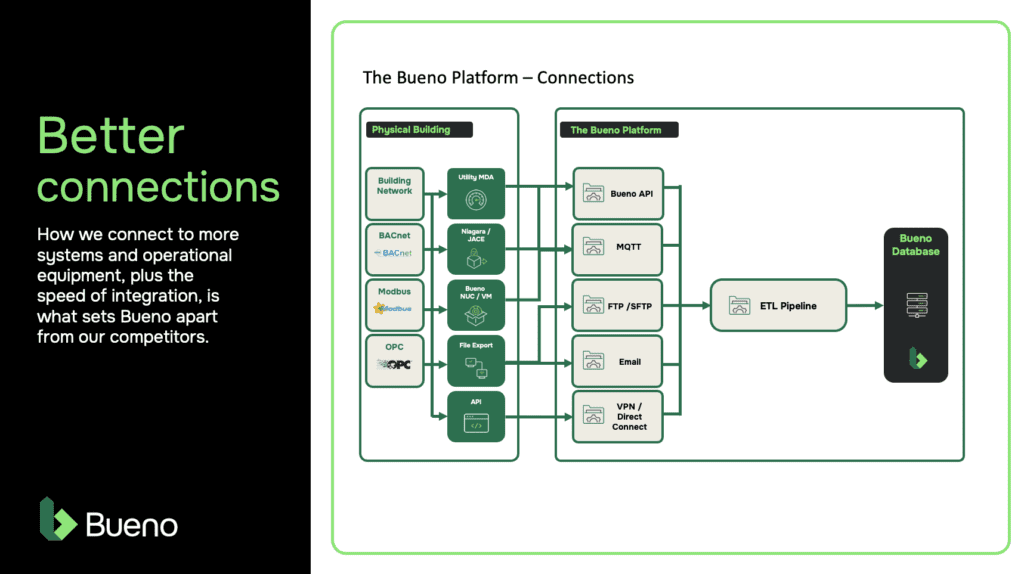
Bueno Analytics provides cutting-edge technology to seamlessly integrate your building’s systems to effectively manage energy usage, fault detection and diagnostics and building optimisation. Learn more about how partnering with Bueno for whole of building integration can improve your portfolio’s financial, operational and environmental outcomes and achieve your goals.