
Energy Optimisation for Grocery
Find the energy savings hiding in your store fleet, then keep every store performing at its best.
Bueno’s Energy Optimisation shows how far every store has drifted from where it should be, and how much further each could improve, using a weather-normalised model built for grocery. It ranks your fleet by deviation and dollar impact, not alarm volume, so your team knows exactly where the savings are. It connects to meters, sub-meters and systems from any manufacturer, and your team makes every change.
Energy management usually catches problems after they start, such as a store drifting off track or a system losing efficiency. But many stores also run well below their true performance potential from day one, not because something broke, but because they were never optimised in the first place. Bueno tackles both.
Bueno Energy Optimisation is the only weather-normalised energy model built for grocery.
AT A GLANCE
20%
Reduction in energy consumption at Woolworths
20 to 30%
Reduction in carbon emissions
10+ years
Of proven performance
Connects
To meters, sub-meters and systems from any manufacturer
Key facts about Energy Optimisation
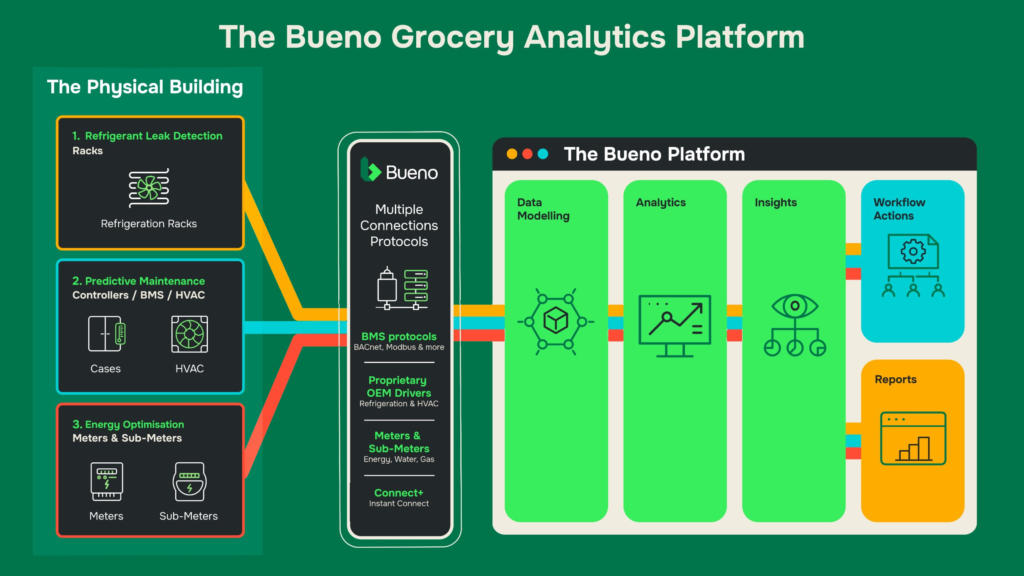
- Energy Optimisation is one of three Bueno grocery solutions, with Refrigerant Leak Detection and Predictive Maintenance. All three run on one data model.
- Energy Slip is a weather-normalised model that predicts what each store should use. It flags stores using more energy than expected, before it shows up as a lost quarter.
- Energy Insights shows how much further each store could improve against its full potential, not just where performance has slipped.
- The fleet is ranked by deviation and dollar impact, not alarm volume, so effort goes where it actually delivers savings.
- The likely cause is traced to the equipment. It works across refrigeration, HVAC and sub-meter data from any manufacturer.
- Bueno is agnostic. It connects to meters, sub-meters and systems from any manufacturer. Bueno analyses and recommends, and your team makes every change. It never controls your equipment.
- At Woolworths, since 2016, Bueno has turned energy drift into a ranked, weekly action list across more than 1,200 stores, with more than AUD 80 million (about US$55 million) in verified annual energy savings.
What is energy optimisation in grocery?
Energy optimisation finds the energy savings sitting across a store fleet, in stores that have drifted off track and in stores that were never optimised in the first place. Bueno uses a weather-normalised model to predict what each store should use, flags the stores using more than expected, and shows how much further each could improve.
Because the fleet is ranked by deviation and dollar impact, your team works on the stores with the biggest savings first, instead of chasing alarm volume. The likely cause is traced to the equipment, across refrigeration, HVAC and sub-meter data from any manufacturer.
Data Bueno reads
- Meters and sub-meters (energy, water, gas)
- Refrigeration data
- HVAC data
- Weather data, to normalise each store
- From any manufacturer
Key terms in energy optimisation
Energy Slip
A weather-normalised measure of how far a store has drifted from where it should be.
Weather-normalised model
A model that predicts a store’s expected energy use after allowing for the weather, so stores can be compared fairly.
Energy Insights
Analysis of how much further a store could improve against its full potential.
Sub-meter
A meter that measures the energy use of one part of a building or system, such as refrigeration or HVAC, instead of the whole store.
WHAT BUENO DOES
What does Bueno Energy Optimisation do?
Bueno Energy Optimisation shows where the energy savings are across your whole portfolio, in one view.
Energy Slip detection
A grocery specific, weather-normalised model that flags stores using more energy than expected, before it shows up as a lost quarter.
Fleet wide opportunity mapping
See where every dollar of energy savings potential sits across your network, not just where performance has slipped, but how far each store could improve from its baseline.
Ranked, actionable insights
Stores are prioritised by deviation and dollar impact, not alarm volume, so effort goes where it actually delivers savings.
Fully agnostic, whole fleet visibility
Bueno connects to meters, sub-meters and systems from any manufacturer, for a complete view with zero blind spots.
Built to scale
Bueno Energy Optimisation works alongside Refrigerant Leak Detection and Predictive Maintenance, so energy performance is never managed in isolation.
EXAMPLE: ENERGY SLIP
What does Energy Slip look like in practice?
Energy Slip is one example of how Bueno finds savings. A weather-normalised model predicts what each store should use, and Bueno flags the store when its actual energy use moves above the expected range.
- A weather-normalised model predicts what each store should use.
- Stores using more than expected are flagged, and the likely cause is traced to the equipment.
- The fleet is ranked by deviation and cost, not alarm count, so effort goes where the money is.
- It works across refrigeration, HVAC and sub-meter data from any manufacturer.
Example: monthly energy, one store
How does Bueno Energy Optimisation differ from usual energy management?
Usual energy management catches problems after they start, while Bueno Energy Optimisation also finds the stores that were never optimised in the first place, and ranks every store by deviation and dollar impact.
| Topic | Usual Energy Management | Bueno Energy Optimisation |
|---|---|---|
| What it looks for | Problems after they start, such as a store drifting off track or a system losing efficiency | How far every store has drifted from where it should be, and how far it could improve against its full potential |
| How stores are ranked | By alarm volume | By deviation and dollar impact |
| Which stores it finds | Stores that have slipped | Every store, including stores that were never optimised in the first place |
Why does energy optimisation matter for grocery?
Energy optimisation matters for grocery because refrigeration is often a store’s largest load, so small drift, repeated across hundreds of stores, becomes a big number.
Energy cost
Refrigeration is often a store’s largest load. Small drift, repeated across hundreds of stores, becomes a big number.
Hidden potential
Many stores run well below their true performance potential from day one, not because something broke, but because they were never optimised in the first place.
Prioritising the right stores
Stores are prioritised by deviation and dollar impact, not alarm volume, so effort goes where it actually delivers savings.
Emissions
Energy savings also cut emissions. At Woolworths, carbon emissions are down 27% since the 2015 baseline.
How does Bueno connect to meters, refrigeration and HVAC?
Energy Optimisation reads meters and sub-meters, plus the rack controllers, case controllers and HVAC BMS you already have, from any manufacturer, through a gateway, API or proprietary protocols, including Connect+. Meters and sub-meters can cover energy, water and gas.
That same data model powers all three Bueno grocery solutions: Refrigerant Leak Detection, Predictive Maintenance and Energy Optimisation. Select a solution in the diagram to see which connections it reads and what it delivers.
 AI
| Solution | Connections It Reads | What It Delivers |
|---|---|---|
| Refrigerant Leak Detection | Rack controllers | Lower leak rates, regulatory compliance, fewer emergency callouts, evidence backed reporting, foundation for optimisation |
| Predictive Maintenance | Rack controllers, case controllers, HVAC BMS | Fewer after hours callouts, early warning on alarms, condition based maintenance, one visit with multiple fixes, longer equipment life |
| Energy Optimization | Rack controllers, case controllers, HVAC BMS, meters and sub-meters | Reduced energy drift, lower operating costs, optimised system performance, data backed prioritisation, improved sustainability |
How does energy drift become a ranked action list?
Bueno turns energy drift into a ranked, weekly action list in a short loop that takes meter and controller data to a fix, and gets smarter each time.
1
Connect
Existing controllers, meters and sub-meters, any brand, through a gateway, API or proprietary protocols, including Connect+.
2
Detect
3
Prioritise
Stores are ranked by deviation and dollar impact. AI writes the work order in plain language.
4
Act
Your team makes the change, and feedback enhances the rules.
Ranked by money, not alarms
Stores are prioritised by deviation and dollar impact, not alarm volume, so effort goes where it actually delivers savings. The result is a ranked, weekly action list across your fleet.
What results has Bueno delivered?
Bueno Analytics has been working with Woolworths since 2016. Our Energy Slip model has helped turn energy drift into a ranked, weekly action list across more than 1,200 stores. Across a decade, Bueno has also helped deliver approx AUD $80M each year on average in savings across energy, while reducing refrigerant leaks and reducing maintenance call outs.
AUD 80M+
Verified annual energy savings (about US$55M+)
27%
Reduction in carbon emissions since the 2015 baseline
20%
Portfolio energy savings
178,000+
Connected devices across 1,200+ stores
Which Bueno solution should I start with?
Refrigerant Leak Detection, Predictive Maintenance and Energy Optimisation run on one data model, so you can start with any of them and add the others.
Find It
Fix It
3
Energy Optimization
Save It
How does a rollout typically start?
1
Discovery
2
Pilot plan
3
Pilot
Energy Optimisation FAQ
What is energy optimisation in grocery?
Energy optimisation finds the energy savings sitting across a store fleet, in stores that have drifted off track and in stores that were never optimised in the first place. Bueno ranks the fleet so your team knows where the savings are.
What is Energy Slip?
Energy Slip is Bueno's weather-normalised model. It predicts what each store should use and flags stores using more energy than expected, and the likely cause is traced to the equipment.
What are Energy Insights?
Energy Insights analyses how much further a store could improve against its full potential, then ranks the fleet so your team knows exactly where the savings are.
How does Bueno rank stores?
By deviation and dollar impact, not alarm volume, so effort goes where it actually delivers savings.
What data does Energy Optimisation need?
It works across meters, sub-meters, refrigeration and HVAC data from any manufacturer. It needs the meter and sub-meter connections to be in place.
Does Bueno work with my controllers, meters and building management system (BMS)?
Yes. Bueno is agnostic and connects to meters, sub-meters, controllers and BMS from any manufacturer, through a gateway, API, proprietary protocols or Connect+.
Does Bueno change my equipment settings automatically?
No. Bueno analyses and recommends. Your team or contractor makes every change.
How does Bueno find stores that were never optimised?
Energy Insights analyses how much further each store could improve against its full potential, not just where performance has slipped.
What energy savings has Bueno delivered?
At Woolworths, since 2016, more than AUD 80 million (about US$55 million) in verified annual energy savings, 20% portfolio energy savings and a 27% reduction in carbon emissions since the 2015 baseline, across more than 1,200 stores.
Which connections does each Bueno grocery solution use?
Refrigerant Leak Detection reads rack controllers. Predictive Maintenance reads rack controllers, case controllers and the HVAC BMS. Energy Optimisation reads those and adds meters and sub-meters. All three run on one data model.
Talk to Bueno about energy optimisation for your network
Speak with Bueno about finding the energy savings hiding in your fleet, and keeping every store performing at its best.